AI-powered employee training:
Turn your company documents into interactive courses with Foxtery
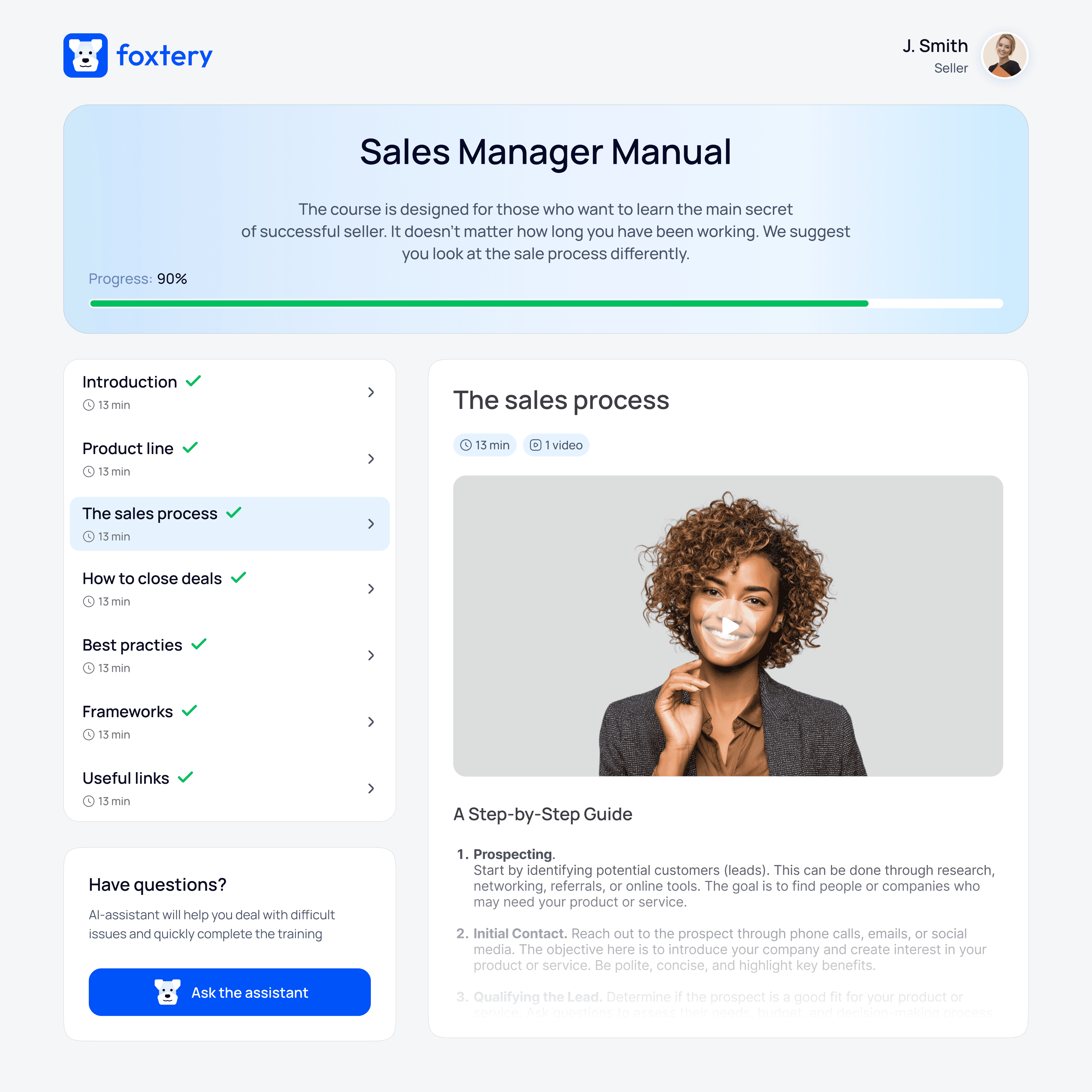
One platform for all your business learning needs
AI is transforming how companies onboard and train employees. Instead of spending weeks turning PDFs, SOPs, and slide decks into courses, teams can now upload existing documents and get interactive training in minutes.
In today’s market, where products evolve weekly, teams scale rapidly, and AI accelerates every function, businesses simply can’t afford manual training processes anymore.
Those that continue to rely on them risk significant losses:
€50K
on average is lost when a new hire underperforms due to poor onboarding
20-30%
of annual revenue is lost by companies that rely on manual processes instead
of integrating AI
6 weeks
after the product ships, manual training for employees is finally ready causing lost deals
Manual training is no longer just inefficient. It creates operational drag, slows growth,
and turns knowledge into a bottleneck instead of a competitive advantage.
This guide explains what AI-powered employee training is, how it works, where it fits alongside your LMS and authoring tools, and how Foxtery helps fast-growing teams turn internal documentation into engaging onboarding, enablement, product, and AI training without needing a dedicated L&D department.
What is AI-powered employee training?
AI-powered employee training uses artificial intelligence to automatically create, personalize, and deliver learning experiences based on your existing content and your employees’ needs.
Instead of manually storyboarding, designing slides, and writing quiz questions, AI analyzes company documents such as SOPs, handbooks,
product documentation, and policies, then restructures them into interactive lessons
with knowledge checks and practice scenarios.
Foxtery is an AI-powered employee training platform that turns company documents
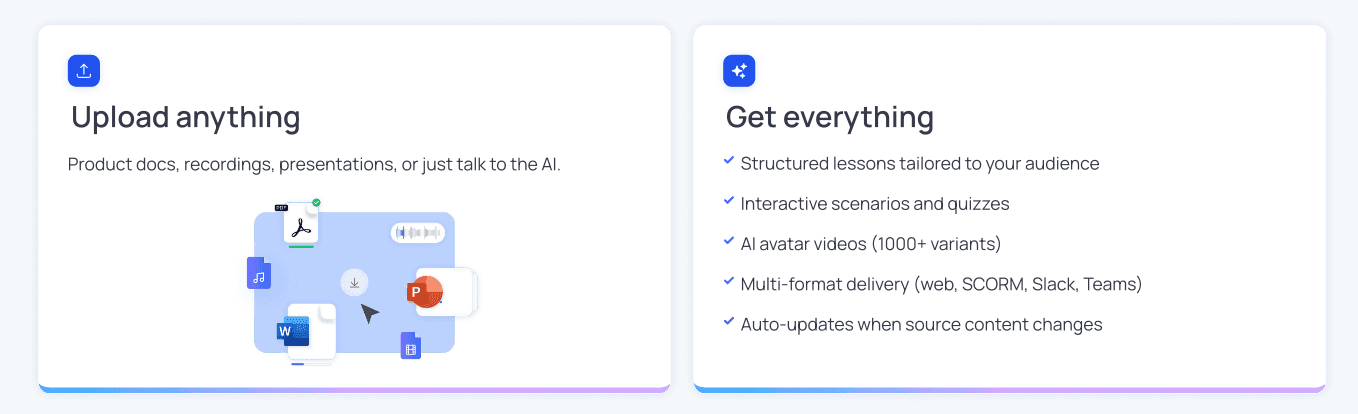
into interactive training in about 30 minutes. In practice, the process looks like this:
Key benefits of AI-powered employee training
AI-powered employee training changes not just how fast you build courses, but how effective
and scalable your training becomes across the company.
Speed
Turning a 60-page SOP into a course used to take weeks of scripting, structuring, and design. With AI, you upload the document, review the proposed modules and assessments, and publish. A non-L&D manager can go from document to interactive course in about 30 minutes.
Consistent training from one source of truth
Turning a 60-page SOP into a course used to take weeks of scripting, structuring, and design. With AI, you upload the document, review the proposed modules and assessments, and publish. A non-L&D manager can go from document to interactive course in about 30 minutes.
Role-based training
Instead of giving everyone the same generic course, you define the team and the goal. The AI tailors the training to their actual responsibilities. Sales teams learn what helps them close deals. Support teams focus on real customer scenarios. Operations teams get process clarity that matches their daily work.
Keeping training continuously up to date
When product features, policies, or processes change, training often lags behind. With AI-powered training, you update the source material and refresh the course in minutes. No rebuilding from scratch and no knowledge gaps between what changed and what employees know.
AI role-play simulations
Completion rates do not equal readiness. With AI role-play simulations, employees practice real conversations and real scenarios. They handle objections, answer difficult questions, and apply knowledge before they speak to actual customers.
Scales with growth
Manual training breaks when teams grow. AI-powered training scales with you. As you hire more people or expand to new roles and locations, you can adapt onboarding and rollout updates quickly without increasing manual workload.
Reduced dependency on L&D specialists
You do not need a full instructional design team to create structured training. Operations leaders, team leads, and HR teams can build effective courses directly from existing documentation without mastering complex authoring tools.
How AI-powered employee training with Foxtery works step-by-step
When creating courses with Foxtery, you follow a clear and predictable workflow from raw documents to a ready-to-launch interactive course.
The entire process is structured into five steps. At each stage, you stay in full control
of how the AI agent transforms your input into the final training experience.
The process includes:
Creating a brief
Uploading documents
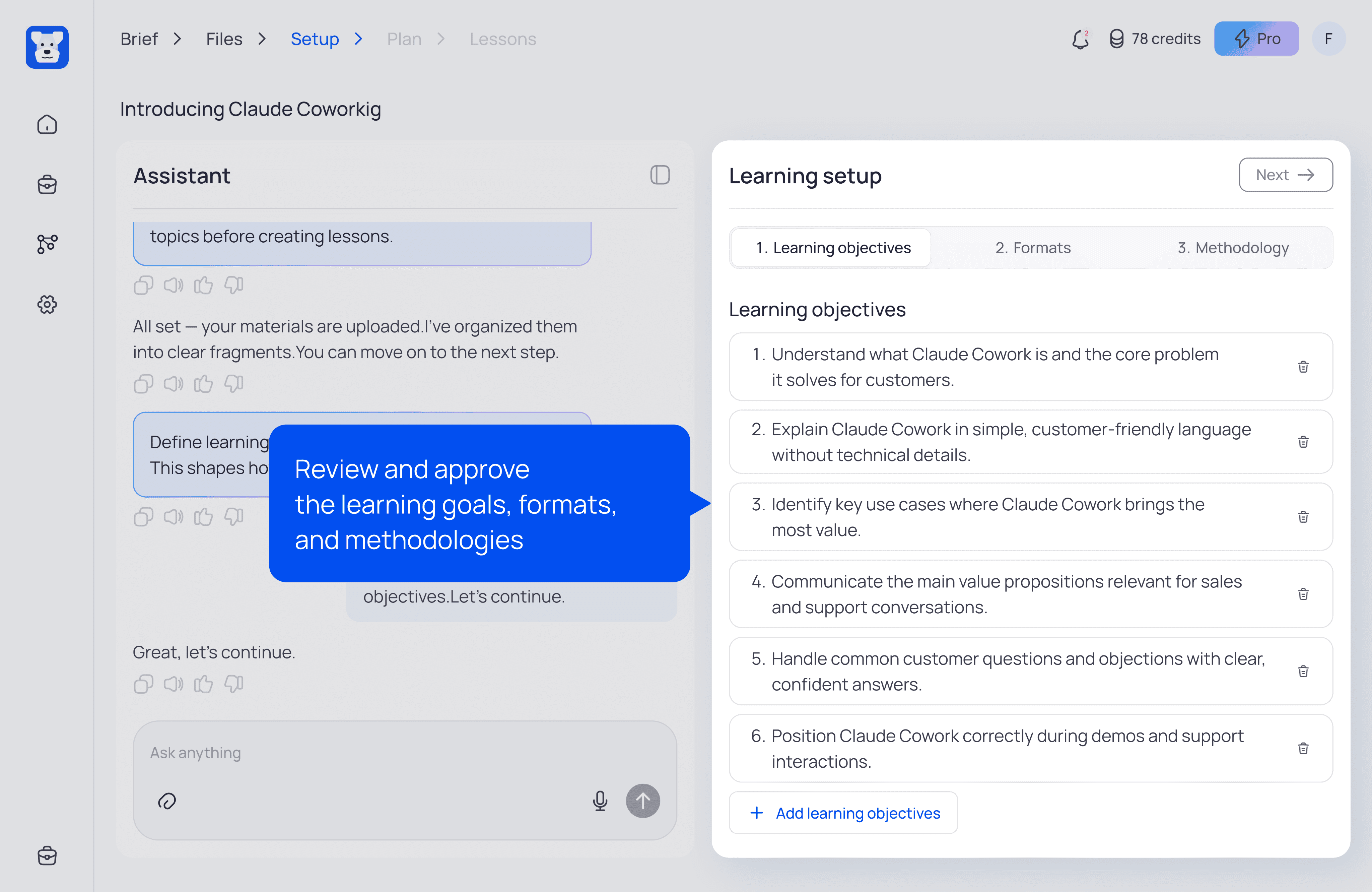
Approving learning objectives, formats, and methodologies
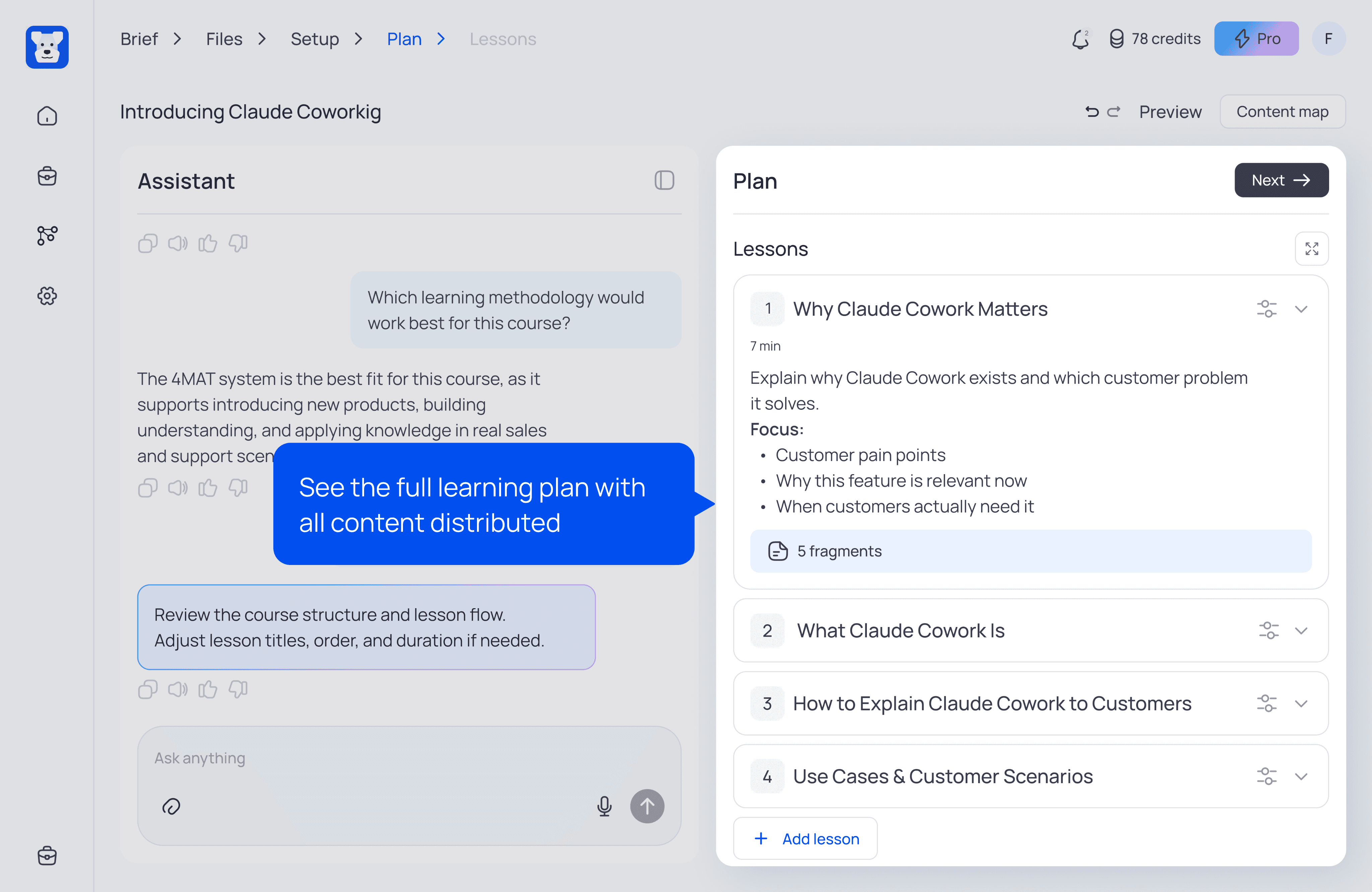
Reviewing the course structure
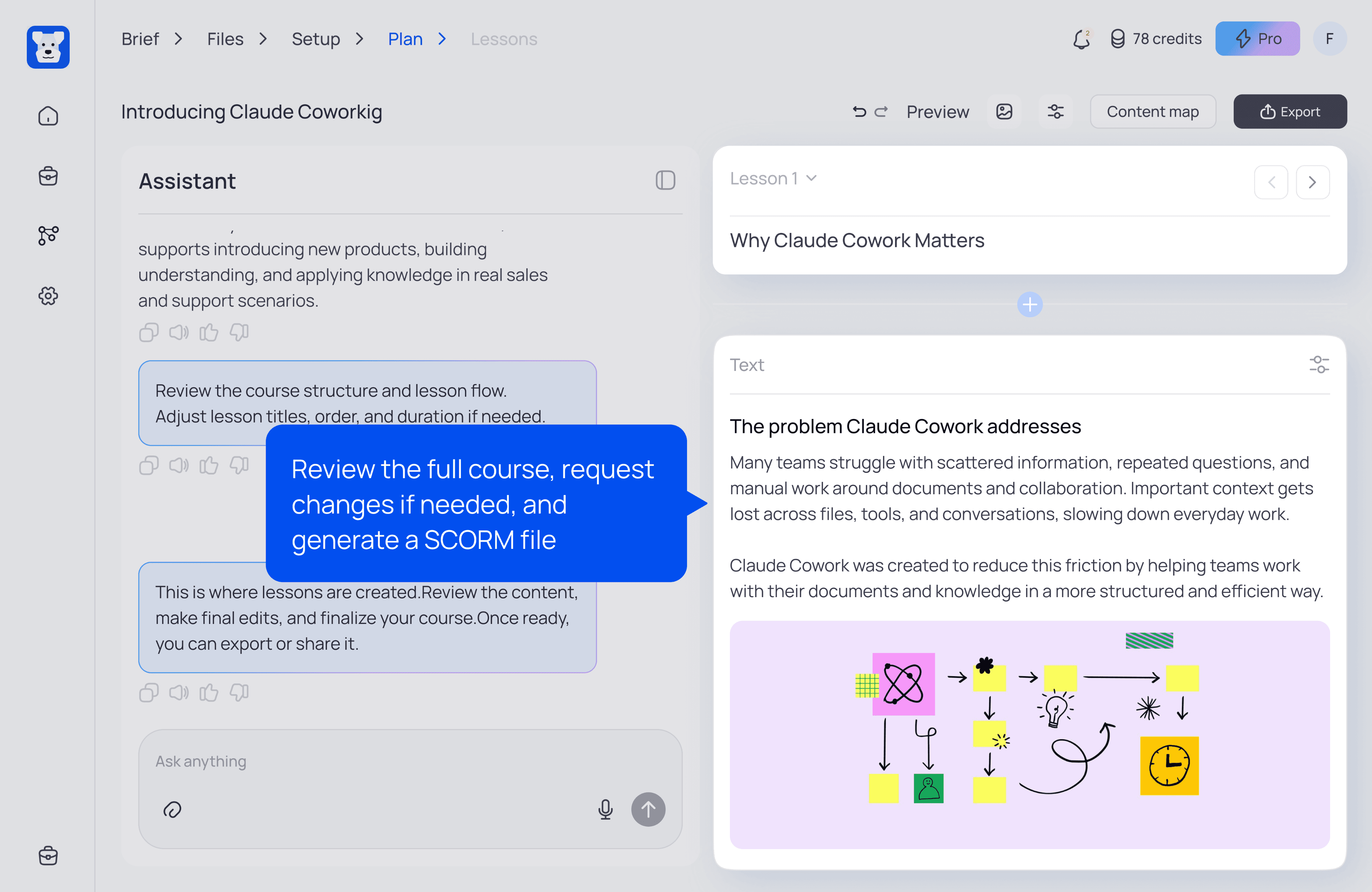
Reviewing each lesson before publishing
This is what the full process looks like:
1
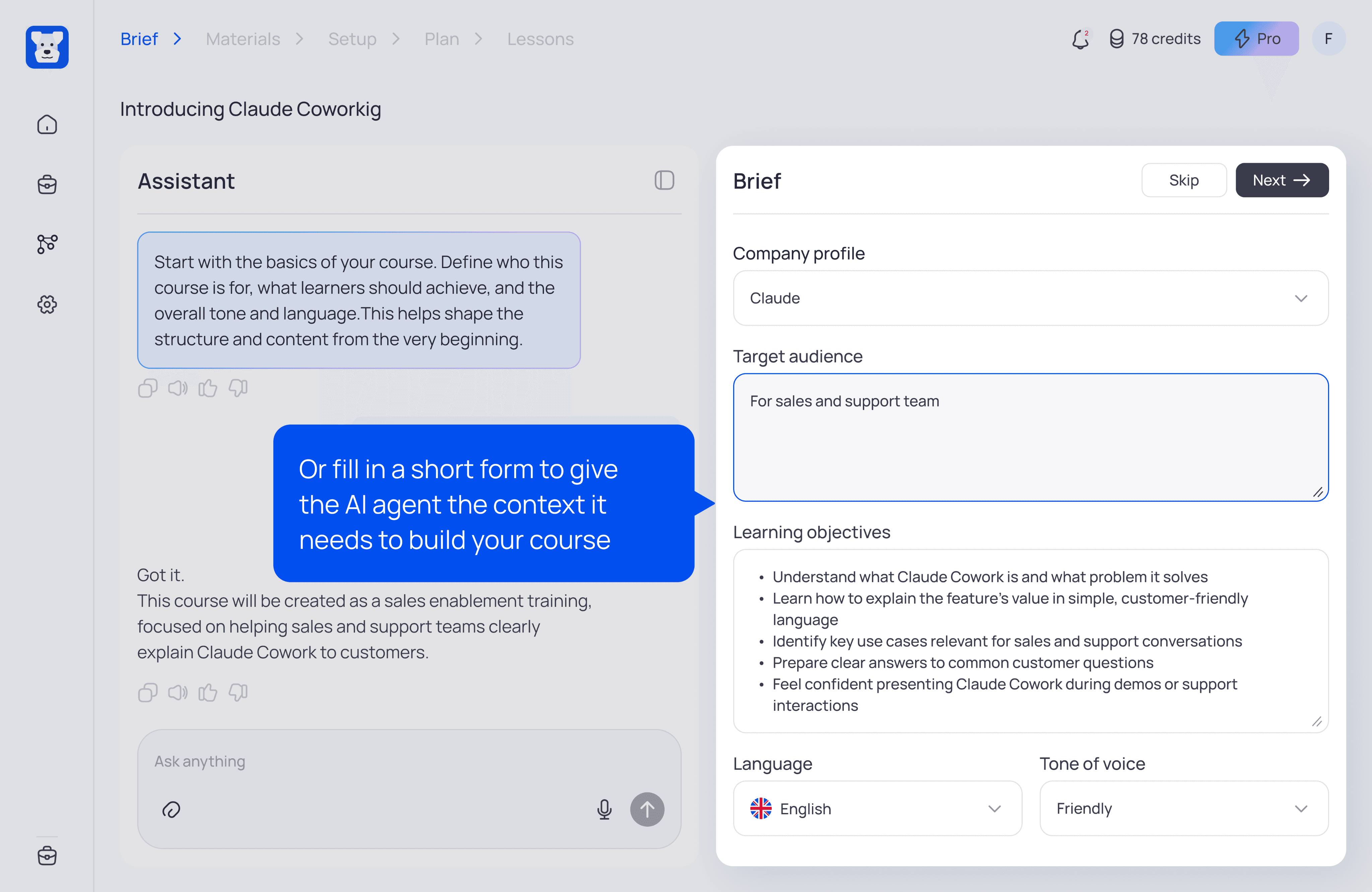
Step 1: Define your training brief
Specify who the training is for, the key learning goals, and the expected business outcomes.
The clearer your brief, the better the AI aligns the course with your objectives.
2
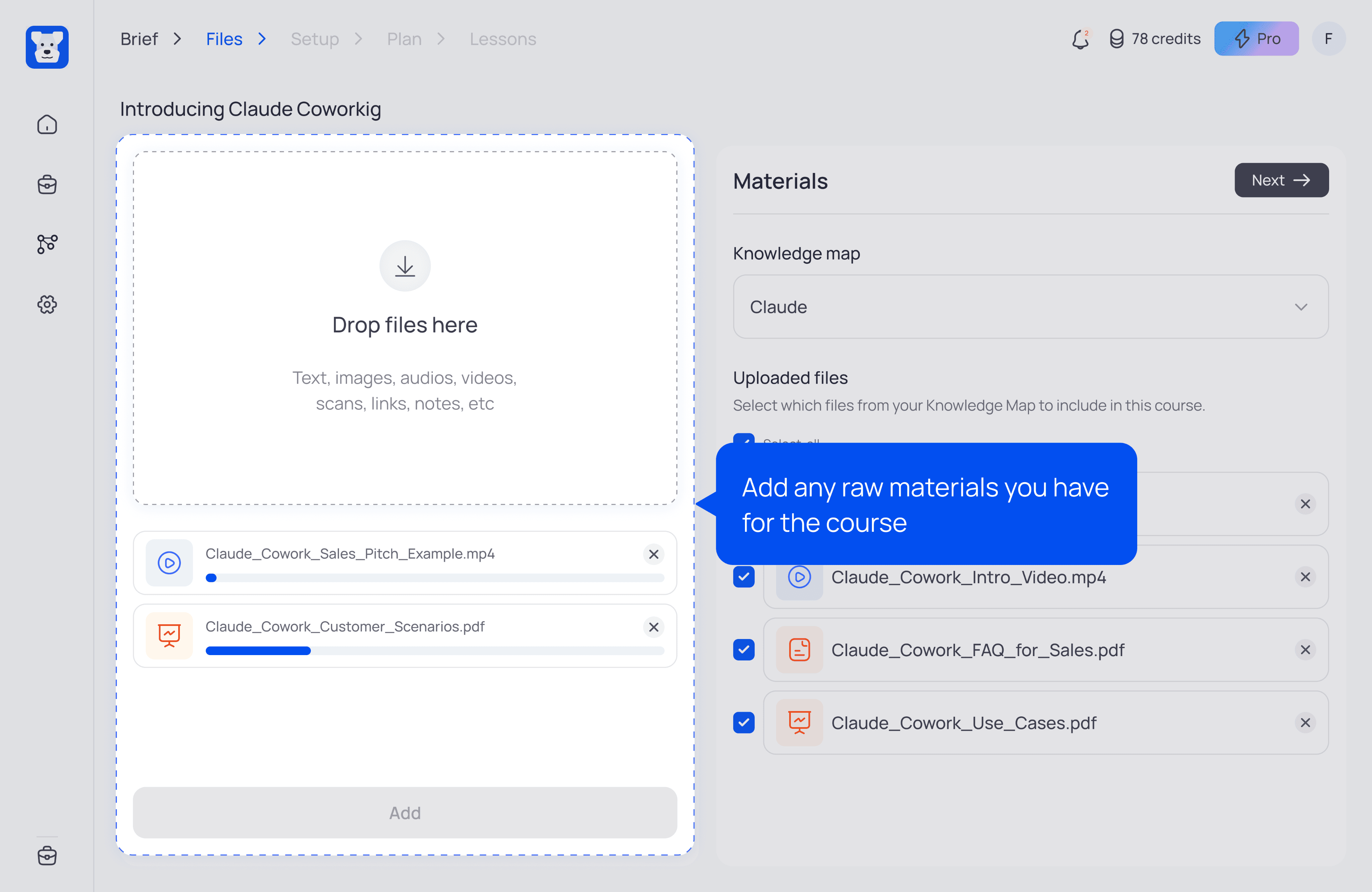
Step 2: Upload your knowledge sources
Upload your materials such as SOPs, product docs, policies, slides, recordings, or videos.
Foxtery builds a structured Knowledge Map and uses only your content to generate the course.
3
Step 3: Approve learning objectives and formats
The AI acts like an experienced L&D expert, generating learning objectives and selecting
the right interactive formats such as simulations and knowledge checks. You can approve
or adjust everything before moving forward.
4
Step 4: Review the course plan
The system creates a structured outline and shows how your materials are used in each module. You confirm that all critical information is covered.
5
Step 5: Review lessons and interactive elements
See the full course lesson by lesson with all interactive components. You can instantly request additions or changes through the AI chat interface.
The AI acts like an experienced L&D expert, generating learning objectives and selecting the right interactive formats such as simulations and knowledge checks. You can approve or adjust everything before moving forward.
Updating courses with AI-powered employee training takes minutes
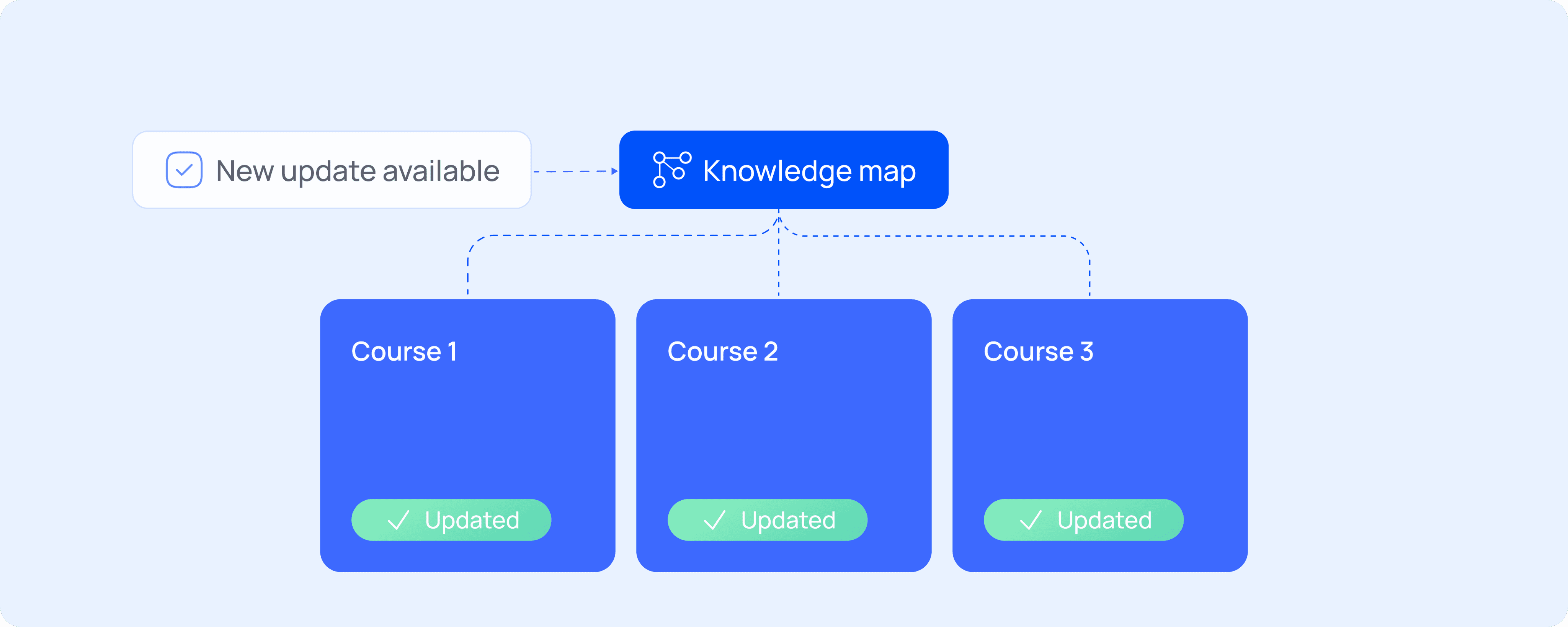
The Knowledge Map created from your uploaded documents becomes a living system.
When something changes such as a product update, policy revision, or process improvement,
you simply add the new information to the Knowledge Map and instruct the AI to update the course accordingly.
The system adjusts only the affected parts of the training. You do not need to rebuild the course from scratch.
This ensures that all training stays aligned with your latest documentation and can be updated
in minutes instead of weeks.
Where Foxtery fits vs traditional LMS and authoring tools
Many organizations already use a Learning Management System or manual authoring tools. However, these systems do not remove the manual work of course creation.
Foxtery is designed to eliminate the time-consuming process of building courses from scratch. Instead of spending weeks planning, structuring, and designing training manually, you generate interactive courses directly from your existing documentation.
Foxtery also supports SCORM export, which makes it compatible with your existing LMS.
You do not need to replace your current system. Foxtery can act as your AI-powered course creation engine while your LMS continues to handle hosting, delivery, and reporting.
Let’s break down the key differences.
LMS
Hosts and distributes training. Does not create course content.
Authoring Tools
Manually build courses with
full design control. Require
time and expertise.
Foxtery AI Course Builder
Generates interactive training from your documents.
Works with any LMS.
LMS
A Learning Management System is designed for hosting, delivering, and tracking training. It manages users, enrollments, completion records, certifications, and compliance reporting, but typically assumes that course content is created elsewhere and then uploaded into the system.
Authoring Tools
Authoring tools are used to manually design and build course content. They offer deep control over layout, interactions, multimedia, and branding, but require instructional design skills and significant time investment, as course structure, objectives, content, and interactions must
all be planned and built manually.
Foxtery AI Course Builder
Foxtery sits between your raw documentation and your delivery platform, automating course creation from existing company materials. You upload documents and define the goal, and the AI builds a structured, interactive course aligned with your business objectives, ready to deliver within a day.
Traditional approaches often require L&D professionals or course designers. Foxtery is built for managers, operations leaders, HR teams, enablement teams, and founders who understand the business process but are not instructional designers.
Key use cases for AI-powered employee training
AI-powered employee training is most valuable when knowledge changes quickly
and teams need to apply it immediately in real work situations.
Sales enablement
Sales teams need to stay aligned with product updates, positioning, objections, and competitive messaging. AI-powered training turns product documentation, battle cards, and call recordings into structured enablement modules. Reps learn what to say, how
to position value, and how to handle objections before they enter live conversations.
Customer support training
Support teams deal with real customer issues every day. AI converts troubleshooting guides, help center content, and internal SOPs into interactive training with scenario-based practice.
This reduces resolution time, improves consistency, and ensures agents apply the latest product knowledge.
Product training
When new features ship, teams need to understand not just what changed, but why it matters. Product managers can upload release notes and documentation, and AI generates concise modules explaining functionality, use cases, and impact. Sales, support,
and success teams stay aligned without long live sessions.
Onboarding new reps
New hires often depend on shadowing and scattered documentation. AI-powered onboarding turns playbooks and internal knowledge into structured learning paths so every rep gets the same foundation and reaches productivity faster. You can also quickly generate adapted onboarding for any department using the same centralized knowledge base, without rebuilding courses from scratch.
Training on AI tools
As companies adopt AI across departments, employees need to understand how to use these tools responsibly and effectively. AI-powered training helps standardize workflows, usage policies, and best practices, reducing misuse and increasing adoption.
Compliance training
Compliance requirements change, but manual training updates are slow. AI transforms policies and regulatory documents into concise, scenario-based modules with trackable assessments. When regulations update, training can be refreshed in minutes, not months.
Who AI-powered employee training is best for
1
SaaS companies with fast product cycles
If your product updates weekly and your sales and CS teams need to stay aligned with every release, AI-powered training turns release notes into enablement modules instantly. Your go-to-market team is trained before deals are at risk.
2
Go-to-market teams that drive revenue
Sales, customer success, and support teams need practical, conversation-ready training. AI-generated courses and role-play simulations prepare them for real objections and real
scenarios, not just quizzes.
3
Companies becoming AI-first
Organizations rolling out AI tools across departments need fast, structured training on new workflows and usage policies. AI-powered training keeps adoption high and misuse low without constant workshops.
4
Fast-growing teams hiring at speed
When you hire 10, 20, or 50 people at once, managers cannot train everyone manually.
AI-powered onboarding creates consistent, role-based training paths that scale with headcount.
5
Companies without a full L&D department
Operations leaders, HR teams, and founders who own training but lack instructional design resources can turn existing documentation into structured, interactive courses without weeks of manual work.
Limitations and considerations
The quality of AI-generated training depends on your source documents. If SOPs are unclear
or outdated, the generated training may reflect those gaps. Subject matter experts should review both source content and output.
AI does not replace human judgment and coaching. Manager feedback and live practice remain essential, especially for behavioural and leadership skills.
AI-generated training may be too literal for highly creative or nuanced skills. In those cases,
it works best as a complement to human-designed programs.
Data privacy and security must be considered when uploading internal documents.
Organizations should ensure secure storage and proper access controls.
Finally, change management matters. Managers must assign and reinforce courses,
and employees must see the relevance of training to their daily work.
The future of employee training is AI-driven
Traditional course creation was built for a slower world. Today, products evolve weekly, teams scale rapidly, and knowledge becomes outdated faster than courses can be built.
AI-powered employee training changes that model. Instead of manually converting documents into static courses, companies can turn real, working documentation into interactive, trackable training in minutes.
Foxtery is an AI-powered employee training platform that turns company documents into interactive onboarding and training courses in about 30 minutes. It works alongside your existing LMS and tools, eliminating manual authoring while keeping your delivery infrastructure intact.
If your company already has documentation but struggles to keep training aligned with product updates and business speed, AI-powered training is not an optimization. It is an operational advantage.
AI-powered employee training:
Turn your company documents into interactive courses with Foxtery
One platform for all your business learning needs
AI is transforming how companies onboard
and train employees. Instead of spending weeks turning PDFs, SOPs, and slide decks into courses, teams can now upload existing documents and get interactive training
in minutes.
In today’s market, where products evolve weekly, teams scale rapidly, and AI accelerates every function, businesses simply can’t afford manual training processes anymore. Those that continue to rely on them risk significant losses:
€50K
on average is lost when a new hire underperforms due to poor onboarding
20-30%
of annual revenue is lost by companies that rely on manual processes instead of integrating AI
6 weeks
after the product ships, manual training for employees is finally ready causing lost deals
Manual training is no longer just inefficient.
It creates operational drag, slows growth,
and turns knowledge into a bottleneck instead of a competitive advantage.
This guide explains what AI-powered employee training is, how it works, where it fits alongside your LMS and authoring tools, and how Foxtery helps fast-growing teams turn internal documentation into engaging onboarding, enablement, product, and AI training without needing a dedicated L&D department.
What is AI-powered employee training?
AI-powered employee training uses artificial intelligence to automatically create, personalize, and deliver learning experiences based on your existing content and your employees’ needs.
Instead of manually storyboarding, designing slides, and writing quiz questions, AI analyzes company documents such as SOPs, handbooks, product documentation, and policies, then restructures them into interactive lessons with knowledge checks and practice scenarios.
Foxtery is an AI-powered employee training platform that turns company documents into interactive training in about 30 minutes.
In practice, the process looks like this:
Key benefits of AI-powered employee training
AI-powered employee training changes not just how fast you build courses, but how effective
and scalable your training becomes across the company.
Speed
Turning a 60-page SOP into a course used to take weeks of scripting, structuring, and design. With AI, you upload the document, review the proposed modules and assessments, and publish.
A non-L&D manager can go from document
to interactive course in about 30 minutes.
Consistent training from one source
of truth
Turning a 60-page SOP into a course used to take weeks of scripting, structuring, and design. With AI, you upload the document, review the proposed modules and assessments,
and publish.
A non-L&D manager can go from document to interactive course in about 30 minutes.
Role-based training
Instead of giving everyone the same generic course, you define the team and the goal.
The AI tailors the training to their actual responsibilities. Sales teams learn what helps them close deals. Support teams focus on real customer scenarios. Operations teams get process clarity that matches their daily work.
Keeping training continuously up to date
When product features, policies, or processes change, training often lags behind. With AI-powered training, you update the source material and refresh the course in minutes.
No rebuilding from scratch and no knowledge gaps between what changed and what employees know.
AI role-play simulations
Completion rates do not equal readiness. With AI role-play simulations, employees practice real conversations and real scenarios. They handle objections, answer difficult questions, and apply knowledge before they speak to actual customers.
Scales with growth
Manual training breaks when teams grow. AI-powered training scales with you. As you hire more people or expand to new roles and locations, you can adapt onboarding and rollout updates quickly without increasing manual workload.
Reduced dependency on L&D specialists
You do not need a full instructional design team to create structured training. Operations leaders, team leads, and HR teams can build effective courses directly from existing documentation without mastering complex authoring tools.
How AI-powered employee training with Foxtery works step-by-step
When creating courses with Foxtery, you follow
a clear and predictable workflow from raw documents to a ready-to-launch interactive course.
The entire process is structured into five steps.
At each stage, you stay in full control of how
the AI agent transforms your input into the final training experience.
The process includes:
Creating a brief
Uploading documents
Approving learning objectives, formats, and methodologies
Reviewing the course structure
Reviewing each lesson before publishing
This is what the full process looks like:
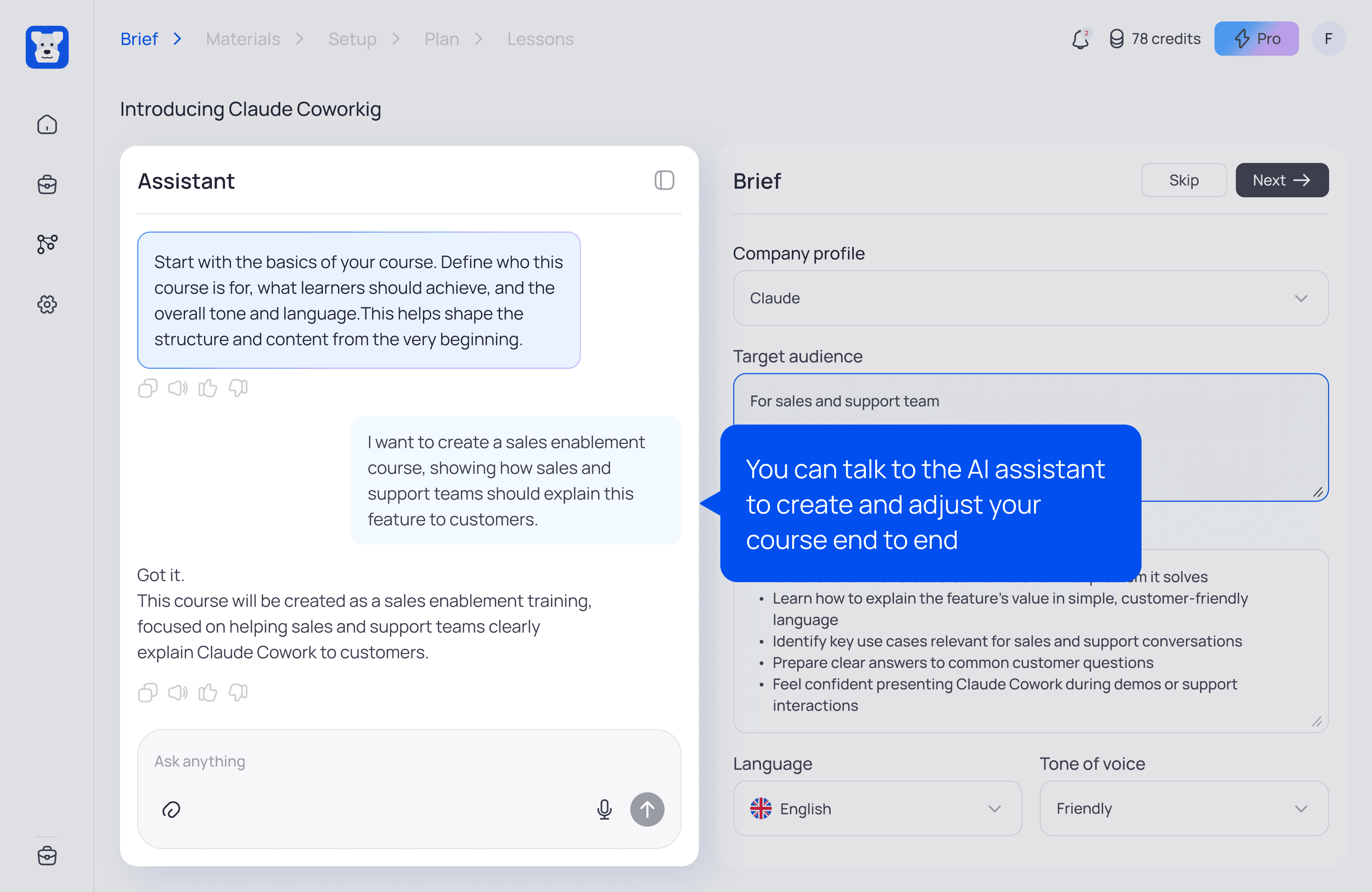
1
Step 1: Define your training brief
Specify who the training is for, the key learning goals, and the expected business outcomes.
The clearer your brief, the better the AI aligns the course with your objectives.
2
Step 2: Upload your knowledge sources
Upload your materials such as SOPs, product docs, policies, slides, recordings, or videos.
Foxtery builds a structured Knowledge Map and uses only your content to generate the course.
3
Step 3: Approve learning objectives
and formats
The AI acts like an experienced L&D expert, generating learning objectives and selecting
the right interactive formats such as simulations and knowledge checks. You can approve
or adjust everything before moving forward.
4
Step 4: Review the course plan
The system creates a structured outline
and shows how your materials are used
in each module. You confirm that all critical information is covered.
5
Step 5: Review lessons and interactive elements
See the full course lesson by lesson with all interactive components. You can instantly request additions or changes through the
AI chat interface.
The AI acts like an experienced L&D expert, generating learning objectives and selecting the right interactive formats such as simulations and knowledge checks. You can approve or adjust everything before moving forward.
Key use cases for AI-powered employee training
AI-powered employee training is most valuable when knowledge changes quickly and teams need to apply it immediately in real work situations.
Sales enablement
Sales teams need to stay aligned with product updates, positioning, objections, and competitive messaging. AI-powered training turns product documentation, battle cards,
and call recordings into structured enablement modules. Reps learn what to say, how to position value, and how to handle objections before they enter live conversations.
Customer support training
Support teams deal with real customer issues every day. AI converts troubleshooting guides, help center content, and internal SOPs into interactive training with scenario-based practice. This reduces resolution time, improves consistency, and ensures agents apply the latest product knowledge.
Product training
When new features ship, teams need to understand not just what changed, but why it matters. Product managers can upload release notes and documentation,
and AI generates concise modules explaining functionality, use cases, and impact.
Sales, support, and success teams stay aligned without long live sessions.
Onboarding new reps
New hires often depend on shadowing and scattered documentation. AI-powered onboarding turns playbooks and internal knowledge into structured learning paths so every rep gets the same foundation and reaches productivity faster. You can also quickly generate adapted onboarding for any department using the same centralized knowledge base, without rebuilding courses from scratch.
Training on AI tools
As companies adopt AI across departments, employees need to understand how
to use these tools responsibly and effectively. AI-powered training helps standardize workflows, usage policies, and best practices, reducing misuse and increasing adoption.
Compliance training
Compliance requirements change, but manual training updates are slow. AI transforms policies and regulatory documents into concise, scenario-based modules with trackable assessments. When regulations update, training can be refreshed in minutes, not months.
Who AI-powered employee training is best for
1
SaaS companies with fast product cycles
If your product updates weekly and your sales and CS teams need to stay aligned with every release, AI-powered training turns release notes into enablement modules instantly.
Your go-to-market team is trained before deals are at risk.
2
Go-to-market teams that drive revenue
Sales, customer success, and support teams need practical, conversation-ready training. AI-generated courses and role-play simulations prepare them for real objections and real scenarios, not just quizzes.
3
Companies becoming AI-first
Organizations rolling out AI tools across departments need fast, structured training on new workflows and usage policies. AI-powered training keeps adoption high
and misuse low without constant workshops.
4
Fast-growing teams hiring at speed
When you hire 10, 20, or 50 people at once, managers cannot train everyone manually. AI-powered onboarding creates consistent, role-based training paths
that scale with headcount.
5
Companies without a full L&D department
Operations leaders, HR teams, and founders who own training but lack instructional design resources can turn existing documentation into structured, interactive courses without weeks
of manual work.
Limitations and considerations
The quality of AI-generated training depends
on your source documents. If SOPs are unclear
or outdated, the generated training may reflect those gaps. Subject matter experts should review both source content and output.
AI does not replace human judgment and coaching. Manager feedback and live practice remain essential, especially for behavioural and leadership skills.
AI-generated training may be too literal for highly creative or nuanced skills.
In those cases,
it works best as a complement to human-designed programs.
Data privacy and security must be considered when uploading internal documents.
Organizations should ensure secure storage and proper access controls.
Finally, change management matters. Managers must assign and reinforce courses,
and employees must see the relevance of training to their daily work.
The future of employee training
is AI-driven
Traditional course creation was built for a slower world. Today, products evolve weekly, teams scale rapidly, and knowledge becomes outdated faster than courses can be built.
AI-powered employee training changes that model. Instead of manually converting documents into static courses, companies can turn real, working documentation into interactive, trackable training in minutes.
Foxtery is an AI-powered employee training platform that turns company documents into interactive onboarding and training courses
in about 30 minutes. It works alongside your existing LMS and tools, eliminating manual authoring while keeping your delivery infrastructure intact.
If your company already has documentation
but struggles to keep training aligned with product updates and business speed,
AI-powered training is not an optimization.
It is an operational advantage.

AI-powered employee training:
Turn your company documents into interactive courses with Foxtery
One platform for all your business learning needs
AI is transforming how companies onboard and train employees. Instead of spending weeks turning PDFs, SOPs, and slide decks into courses, teams can now upload existing documents and get interactive training in minutes.
In today’s market, where products evolve weekly, teams scale rapidly, and AI accelerates every function, businesses simply can’t afford manual training processes anymore. Those that continue to rely on them risk significant losses:
€50K
on average is lost when a new hire underperforms due to poor onboarding
20-30%
of annual revenue is lost by companies that rely on manual processes instead
of integrating AI
6 weeks
after the product ships, manual training for employees is finally ready causing lost deals
Manual training is no longer just inefficient.
It creates operational drag, slows growth, and turns knowledge into a bottleneck instead of
a competitive advantage.
This guide explains what AI-powered employee training is, how it works, where it fits alongside your LMS and authoring tools, and how Foxtery helps fast-growing teams turn internal documentation into engaging onboarding, enablement, product, and AI training without needing a dedicated L&D department.
What is AI-powered employee training?
AI-powered employee training uses artificial intelligence to automatically create, personalize, and deliver learning experiences based on your existing content and your employees’ needs.
Instead of manually storyboarding, designing slides, and writing quiz questions, AI analyzes company documents such as SOPs, handbooks, product documentation,
and policies, then restructures them into interactive lessons with knowledge checks
and practice scenarios.
Foxtery is an AI-powered employee training platform that turns company documents into interactive training in about 30 minutes.
In practice, the process looks like this:
Key benefits of AI-powered employee training
AI-powered employee training changes not just how fast you build courses, but how effective
and scalable your training becomes across
the company.
Speed
Turning a 60-page SOP into a course used to take weeks of scripting, structuring, and design. With AI, you upload the document, review the proposed modules and assessments, and publish.
A non-L&D manager can go from document
to interactive course in about 30 minutes.
Consistent training from one source of truth
Turning a 60-page SOP into a course used
to take weeks of scripting, structuring, and design. With AI, you upload the document, review the proposed modules and assessments, and publish.
A non-L&D manager can go from document
to interactive course in about 30 minutes.
Role-based training
Instead of giving everyone the same generic course, you define the team and the goal.
The AI tailors the training to their actual responsibilities. Sales teams learn what helps them close deals. Support teams focus on real customer scenarios. Operations teams get process clarity that matches their daily work.
Keeping training continuously
up to date
When product features, policies, or processes change, training often lags behind. With AI-powered training, you update the source material and refresh the course in minutes.
No rebuilding from scratch and no knowledge gaps between what changed and what employees know.
AI role-play simulations
Completion rates do not equal readiness. With AI role-play simulations, employees practice real conversations and real scenarios. They handle objections, answer difficult questions, and apply knowledge before they speak to actual customers.
Scales with growth
Manual training breaks when teams grow. AI-powered training scales with you. As you hire more people or expand to new roles and locations, you can adapt onboarding and rollout updates quickly without increasing manual workload.
Reduced dependency on L&D specialists
You do not need a full instructional design team to create structured training. Operations leaders, team leads, and HR teams can build effective courses directly from existing documentation without mastering complex authoring tools.
How AI-powered employee training with Foxtery works step-by-step
When creating courses with Foxtery, you follow a clear and predictable workflow from raw documents to a ready-to-launch interactive course.
The entire process is structured into five steps. At each stage, you stay in full control of how
the AI agent transforms your input into the final training experience.
The process includes:
Creating a brief
Uploading documents
Approving learning objectives, formats,
and methodologies
Reviewing the course structure
Reviewing each lesson before publishing
This is what the full process looks like:
1
Step 1: Define your training brief
Specify who the training is for, the key learning goals, and the expected business outcomes.
The clearer your brief, the better the AI aligns the course with your objectives.
2
Step 2: Upload your knowledge sources
Upload your materials such as SOPs, product docs, policies, slides, recordings, or videos.
Foxtery builds a structured Knowledge Map
and uses only your content to generate the course.
3
Step 3: Approve learning objectives and formats
The AI acts like an experienced L&D expert, generating learning objectives and selecting
the right interactive formats such as simulations and knowledge checks. You can approve or adjust everything before moving forward.
4
Step 4: Review the course plan
The system creates a structured outline
and shows how your materials are used in each module. You confirm that all critical information is covered.
5
Step 5: Review lessons and interactive elements
See the full course lesson by lesson with all interactive components. You can instantly request additions or changes through the AI chat interface.
The AI acts like an experienced L&D expert, generating learning objectives and selecting the right interactive formats such as simulations and knowledge checks. You can approve or adjust everything before moving forward.
Updating courses with AI-powered employee training takes minutes
The Knowledge Map created from your uploaded documents becomes a living system.
When something changes such as a product update, policy revision, or process improvement,
you simply add the new information to the Knowledge Map and instruct the AI to update the course accordingly.
The system adjusts only the affected parts
of the training. You do not need to rebuild the course from scratch.
This ensures that all training stays aligned with your latest documentation and can be updated
in minutes instead of weeks.
Where Foxtery fits vs traditional LMS and authoring tools
Many organizations already use a Learning Management System or manual authoring tools. However, these systems do not remove the manual work of course creation.
Foxtery is designed to eliminate the time-consuming process of building courses from scratch. Instead of spending weeks planning, structuring, and designing training manually, you generate interactive courses directly from your existing documentation.
Foxtery also supports SCORM export, which makes it compatible with your existing LMS.
You do not need to replace your current system. Foxtery can act as your AI-powered course creation engine while your LMS continues
to handle hosting, delivery, and reporting.
Let’s break down the key differences.
LMS
Hosts and distributes training. Does not create course content.
Authoring Tools
Manually build courses with full design control. Require time and expertise.
Foxtery AI Course Builder
Generates interactive training from your documents. Works with any LMS.
LMS
A Learning Management System is designed for hosting, delivering, and tracking training. It manages users, enrollments, completion records, certifications, and compliance reporting, but typically assumes that course content is created elsewhere and then uploaded into the system.
Authoring Tools
Authoring tools are used to manually design and build course content. They offer deep control over layout, interactions, multimedia, and branding, but require instructional design skills and significant time investment, as course structure, objectives, content, and interactions must
all be planned and built manually.
Foxtery AI Course Builder
Foxtery sits between your raw documentation and your delivery platform, automating course creation from existing company materials. You upload documents and define the goal, and the AI builds a structured, interactive course aligned with your business objectives, ready to deliver within a day.
Traditional approaches often require L&D professionals or course designers. Foxtery is built for managers, operations leaders, HR teams, enablement teams, and founders who understand the business process but are not instructional designers.
Key use cases for AI-powered employee training
AI-powered employee training is most valuable when knowledge changes quickly and teams need to apply it immediately in real work situations.
Sales enablement
Sales teams need to stay aligned with product updates, positioning, objections, and competitive messaging. AI-powered training turns product documentation, battle cards,
and call recordings into structured enablement modules. Reps learn what to say, how to position value, and how
to handle objections before they enter live conversations.
Customer support training
Support teams deal with real customer issues every day. AI converts troubleshooting guides,
help center content, and internal SOPs into interactive training with scenario-based practice.
This reduces resolution time, improves consistency, and ensures agents apply the latest product knowledge.
Product training
When new features ship, teams need to understand not just what changed, but why it matters. Product managers can upload release notes and documentation, and AI generates concise modules explaining functionality, use cases, and impact. Sales, support, and success teams stay aligned without long live sessions.
Onboarding new reps
New hires often depend on shadowing and scattered documentation. AI-powered onboarding turns playbooks and internal knowledge into structured learning paths so every rep gets the same foundation and reaches productivity faster. You can also quickly generate adapted onboarding for any department using the same centralized knowledge base, without rebuilding courses from scratch.
Training on AI tools
As companies adopt AI across departments, employees need to understand how to use these tools responsibly and effectively. AI-powered training helps standardize workflows, usage policies, and best practices, reducing misuse and increasing adoption.
Compliance training
Compliance requirements change, but manual training updates are slow. AI transforms policies and regulatory documents into concise, scenario-based modules with trackable assessments. When regulations update, training can be refreshed in minutes, not months.
Who AI-powered employee training is best for
1
SaaS companies with fast product cycles
If your product updates weekly and your sales and CS teams need to stay aligned with every release, AI-powered training turns release notes into enablement modules instantly.
Your go-to-market team is trained before deals are at risk.
2
Go-to-market teams that drive revenue
Sales, customer success, and support teams need practical, conversation-ready training.
AI-generated courses and role-play simulations prepare them for real objections and real scenarios, not just quizzes.
3
Companies becoming AI-first
Organizations rolling out AI tools across departments need fast, structured training on new workflows and usage policies. AI-powered training keeps adoption high and misuse low without constant workshops.
4
Fast-growing teams hiring at speed
When you hire 10, 20, or 50 people at once, managers cannot train everyone manually. AI-powered onboarding creates consistent, role-based training paths that scale with headcount.
5
Companies without a full L&D department
Operations leaders, HR teams, and founders who own training but lack instructional design resources can turn existing documentation into structured, interactive courses without weeks of manual work.
Limitations and considerations
The quality of AI-generated training depends on your source documents. If SOPs are unclear
or outdated, the generated training may reflect those gaps. Subject matter experts should review both source content and output.
AI does not replace human judgment and coaching. Manager feedback and live practice remain essential, especially for behavioural
and leadership skills.
AI-generated training may be too literal for highly creative or nuanced skills. In those cases, it works best as a complement to human-designed programs.
Data privacy and security must be considered when uploading internal documents.
Organizations should ensure secure storage and proper access controls.
Finally, change management matters. Managers must assign and reinforce courses,
and employees must see the relevance of training to their daily work.
The future of employee training is AI-driven
Traditional course creation was built for a slower world. Today, products evolve weekly, teams scale rapidly, and knowledge becomes outdated faster than courses can be built.
AI-powered employee training changes that model. Instead of manually converting documents into static courses, companies can turn real, working documentation into interactive, trackable training in minutes.
Foxtery is an AI-powered employee training platform that turns company documents into interactive onboarding and training courses
in about 30 minutes. It works alongside your existing LMS and tools, eliminating manual authoring while keeping your delivery infrastructure intact.
If your company already has documentation but struggles to keep training aligned with product updates and business speed, AI-powered training is not an optimization. It is an operational advantage.