
Art Maslow
Founder of Foxtery


Most L&D teams spend weeks building strategies that executives skim once, then file away. The disconnect isn't the quality of the work—it's that only 7% of HR leaders believe their workforce is ready for the future, yet training programs continue as if incremental improvement will close that gap.
A learning and development strategy is a structured framework that aligns employee training initiatives with business goals, ensuring the workforce develops capabilities needed for current and future organizational success. The urgency has never been clearer: 39% of core skills will become obsolete by 2030, and organizations face a choice between reactive scrambling and strategic preparation.
This guide presents a data-driven framework built on research from 115,000 learners, addresses the engagement problem that 59% of L&D leaders cite as their biggest obstacle, and provides a template that compresses strategy development from weeks to hours.
Why 93% of Workforces Aren't Ready for 2030 (And What L&D Strategy Actually Fixes)
The workforce readiness crisis isn't coming. It's here. Gartner reports that only 7% of HR leaders consider their workforce prepared for future demands, while the World Economic Forum projects that 39% of core skills will be obsolete within five years. That's not a skills gap—it's a skills chasm.
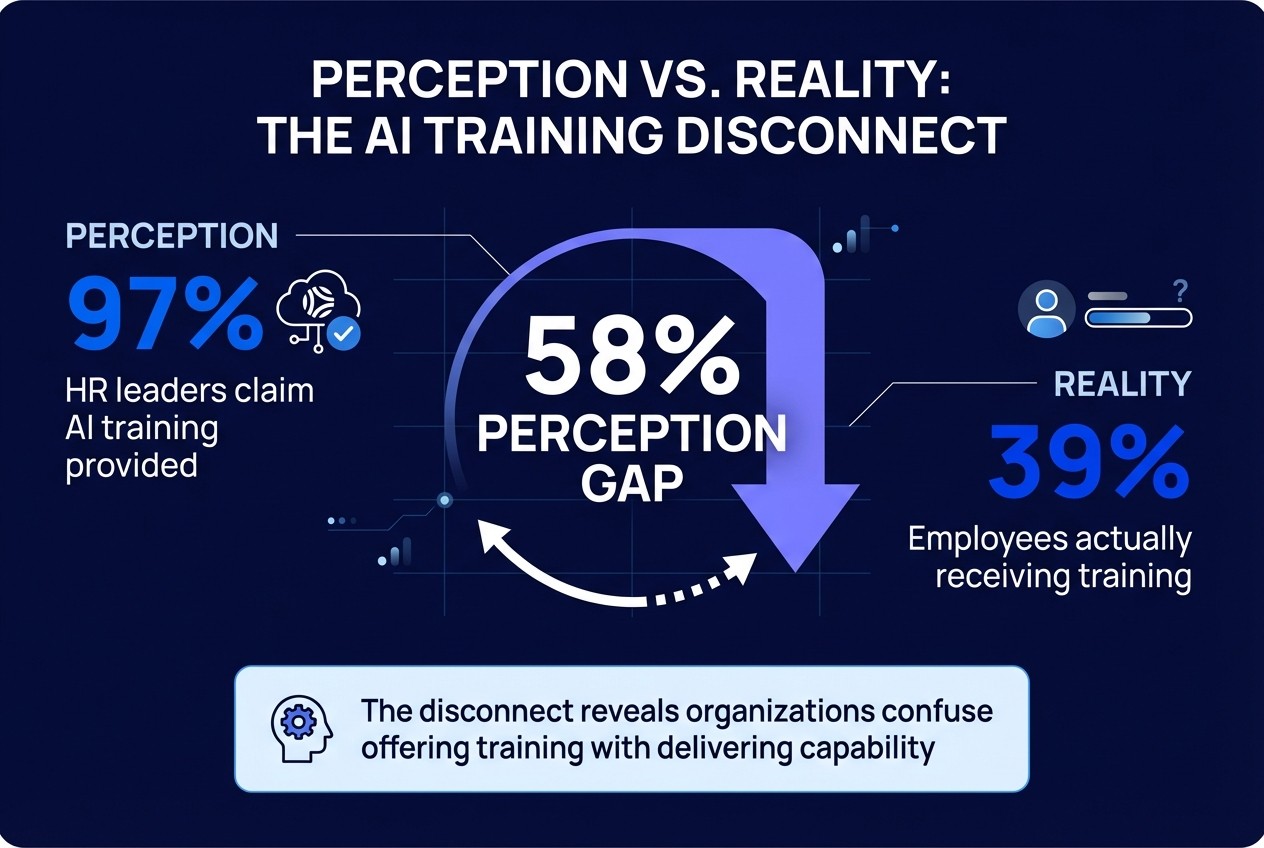
The perception gap compounds the problem. Research from Corndel shows 97% of HR leaders claim their organizations provide AI training, yet only 39% of employees report actually receiving it. The disconnect reveals that most organizations confuse offering training with delivering capability development.
Without a cohesive strategy, training becomes random acts of learning that don't address real skill gaps. Companies launch courses because competitors do, because vendors pitch them, or because they seem relevant—but rarely because they connect to specific business outcomes or workforce capabilities the organization actually needs.
The stakes are concrete: skill gaps lead to productivity loss, which leads to competitive disadvantage. Organizations that treat L&D as a collection of courses rather than a strategic system find themselves perpetually behind, reacting to skill shortages instead of building capabilities ahead of demand.
The L&D Reality Check: What 115,000 Learners Revealed About Training in 2025
Data from 115,000 learners paints a challenging picture. Big Think+ found that 59% of L&D leaders cite employee engagement as their biggest obstacle—not budget, not technology, but getting people to actually participate in learning.
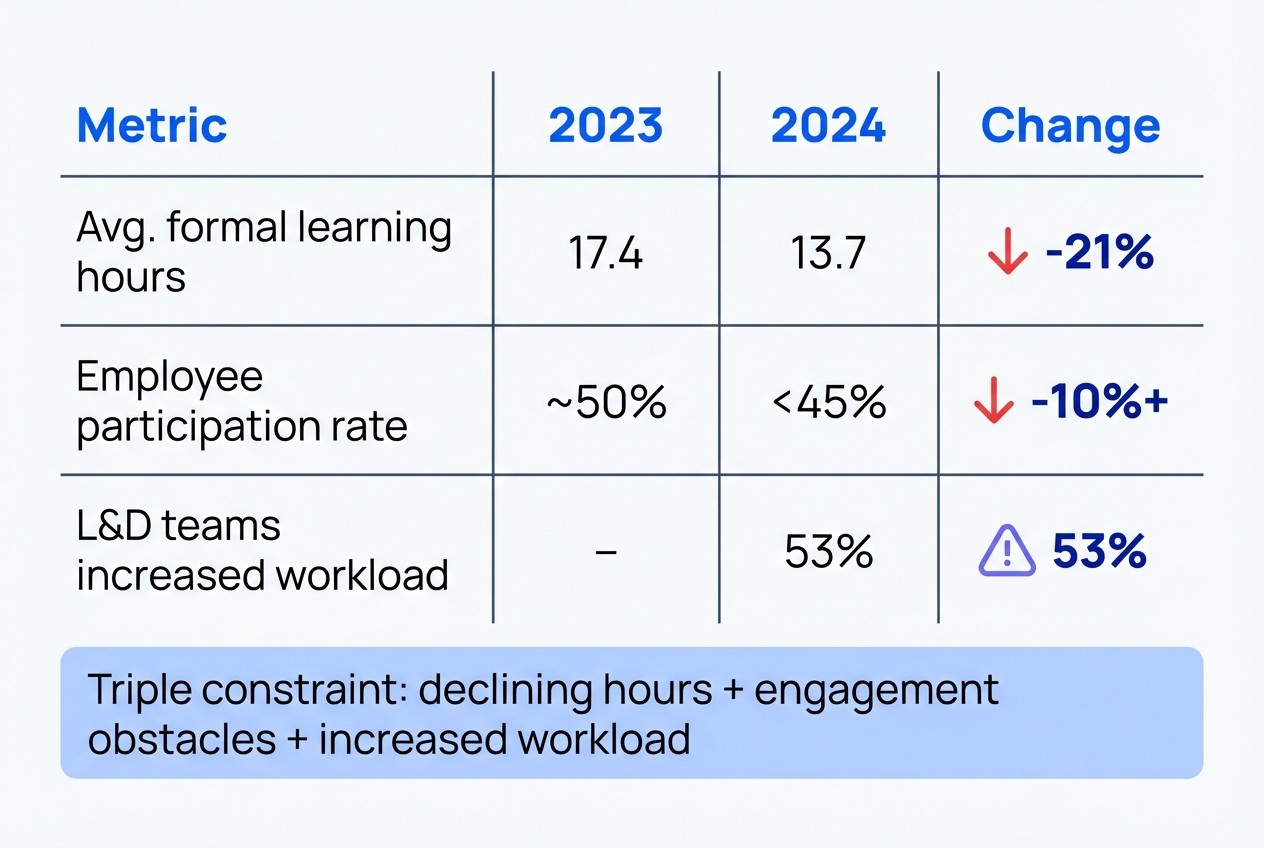
The time crunch is real. ATD reports that average formal learning hours dropped to 13.7 in 2024, down from 17.4 the previous year. That's a 21% decline in a single year. Meanwhile, Gallup data shows less than 45% of U.S. employees participated in job training in 2024.
L&D teams face their own constraints. CIPD research indicates 53% of L&D professionals report increased workload, creating a scenario where teams must do more with less time and fewer resources.
| Metric | 2023 | 2024 | Change |
|--------|------|------|--------|
| Avg. formal learning hours | 17.4 | 13.7 | -21% |
| Employee participation rate | ~50% | <45% | -10%+ |
| L&D teams reporting increased workload | — | 53% | — |
L&D professionals in 2025 face a triple constraint: declining training hours per employee, majority-level engagement obstacles, and increased team workload—requiring strategies that maximize impact with minimal resource drain.
Skills-Based vs. Course-Based: Why 63% More Organizations See Results With the Former
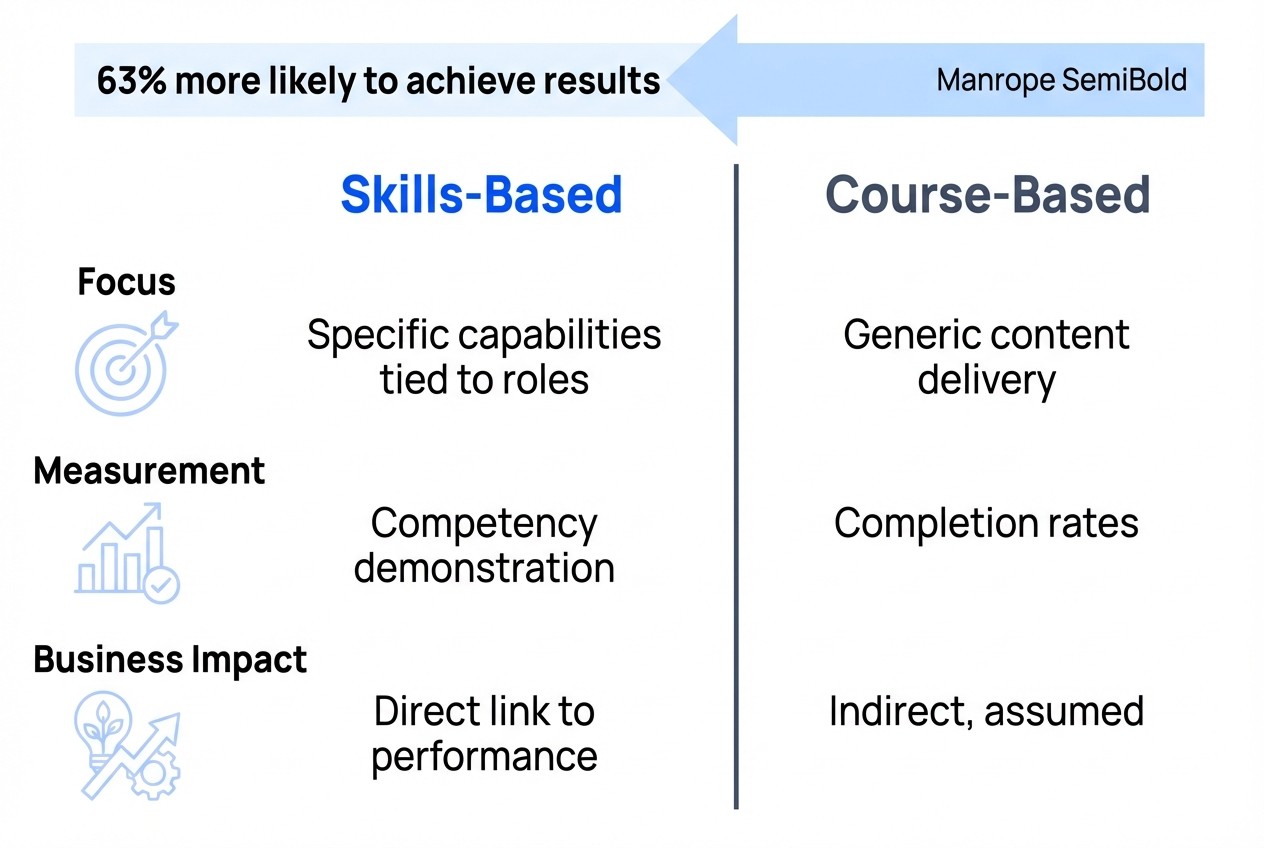
Organizations with skills-based learning are 63% more likely to achieve results than those sticking with traditional course catalogs. The difference isn't subtle.
Skills-based learning is an approach that focuses on specific capabilities employees need to perform current and future work, measured by demonstrated competency rather than course completion. Course-based learning is a model that organizes training around predefined curricula, measured by attendance and satisfaction scores.
| Approach | Focus | Measurement | Business Impact |
|----------|-------|-------------|------------------|
| Skills-based | Specific capabilities tied to roles | Competency demonstration | Direct link to performance |
| Course-based | Generic content delivery | Completion rates | Indirect, assumed |
The skills-based approach directly addresses the 39% obsolescence problem. When organizations know which capabilities matter for business outcomes, they can prioritize development of those skills and sunset outdated ones. Course catalogs, by contrast, accumulate content without strategic pruning.
In practice, skills-based learning means a sales team doesn't take a generic "communication skills" course. They develop specific capabilities: qualifying enterprise deals, navigating procurement processes, or articulating ROI in financial terms. Each skill connects to a business outcome the organization needs.
The 5-Phase L&D Strategy Framework (With Time Estimates for Each)
Building an L&D strategy doesn't require months. The framework below provides realistic timelines, though modern platforms can compress execution significantly. TalentLMS data shows 75% of strategies are now aligned with business KPIs, reflecting the shift from training-for-training's-sake to capability-driven approaches.
Phase 1: Align Learning Goals With Business Objectives (2-3 Weeks)
Start by identifying the top 3-5 business priorities for the next 12-24 months. Not the entire strategic plan—the handful of initiatives that will make or break the year. For each priority, map the required capabilities. If the priority is "expand into enterprise segment," required capabilities might include complex deal navigation, executive stakeholder management, and enterprise implementation planning.
Secure executive sponsorship and budget commitment during this phase. The conversation isn't "we need training." It's "to achieve [business priority], the team needs [specific capabilities], which requires [this investment]." That framing gets budget approved.
Phase 2: Conduct Skills Gap Analysis (3-4 Weeks)
Assess current workforce capabilities against required skills. This doesn't mean testing everyone on everything. Focus on the capabilities mapped in Phase 1. Use a combination of manager assessments, self-assessments, and performance data.
Prioritize gaps by business impact and urgency. A skill gap that affects next quarter's product launch gets higher priority than one relevant to a three-year initiative. Identify high-leverage interventions—the learning initiatives that close multiple gaps or affect large populations.
Phase 3: Design Your Learning Architecture (2-3 Weeks)
Choose delivery modalities based on what works for each skill type. Some capabilities require formal instruction. Others develop through social learning or on-the-job experience. Build learning pathways for critical roles, showing progression from foundational to advanced competency.
Select technology platforms and tools during this phase. The platform choice should support the learning architecture, not dictate it. Evaluate based on how well tools enable the specific learning experiences the strategy requires.
Phase 4: Build Implementation Roadmap (1-2 Weeks)
Create a phased rollout plan with clear milestones. Don't launch everything simultaneously. Start with high-impact, high-visibility initiatives that build momentum and demonstrate results. Allocate resources and assign ownership for each initiative.
Establish communication and change management plans. Employees need to understand why learning matters, what's expected, and how it connects to their work. Managers need to know how to support learning and reinforce application.
Phase 5: Establish Measurement and Iteration Cycles (Ongoing)
Define leading indicators (engagement, completion of key milestones) and lagging indicators (capability development, business impact). Set up data collection mechanisms that don't create administrative burden.
Schedule quarterly strategy reviews to assess what's working and adjust what isn't. L&D strategy is a living document, not a one-time exercise. Market conditions change, business priorities shift, and learning approaches evolve.
How to Overcome the Engagement Problem That 59% of L&D Leaders Face
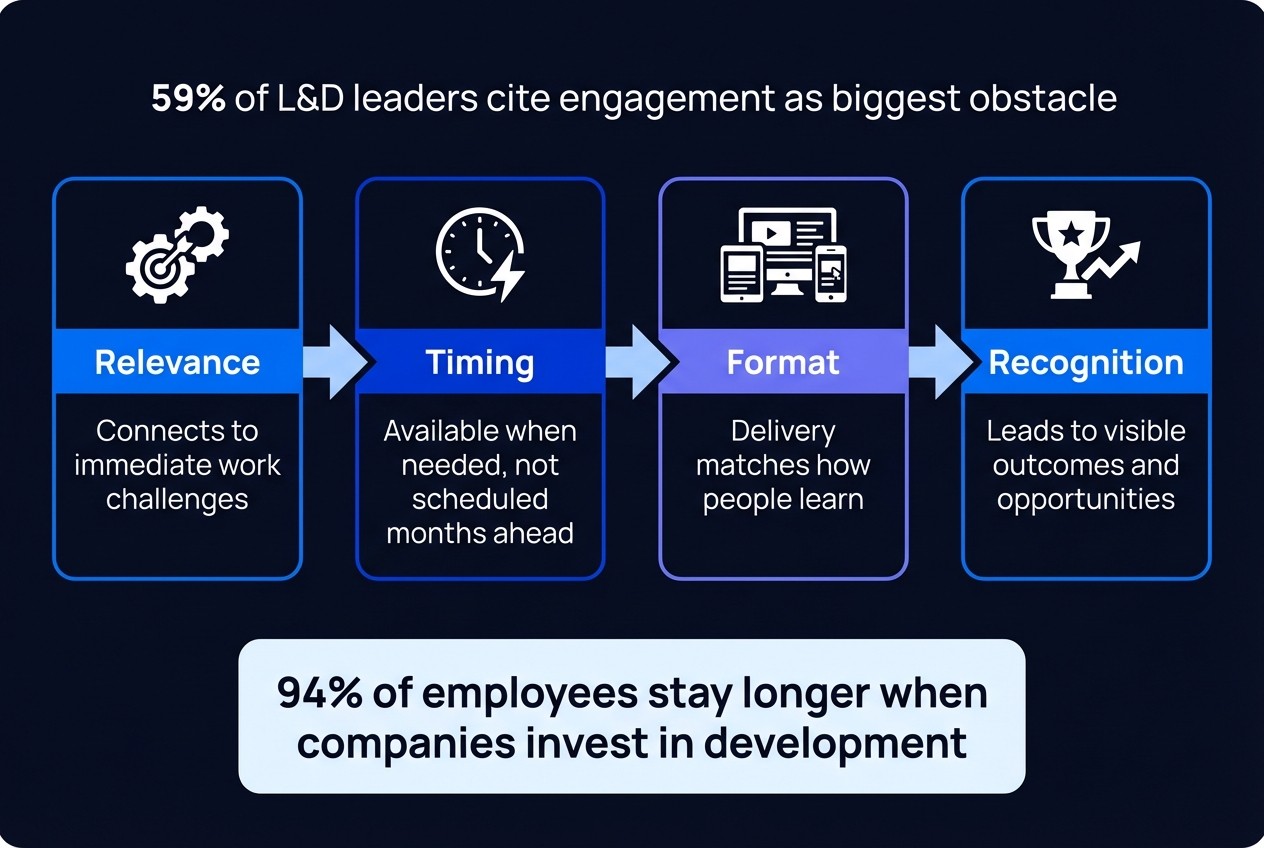
Big Think+ research identifying engagement as the top obstacle for 59% of L&D leaders reflects a fundamental challenge: employees are overwhelmed, and generic training feels like one more thing piled onto an already full plate.
Four evidence-based engagement drivers consistently appear in research: relevance, timing, format, and recognition. Relevance means learning connects to immediate work challenges. Timing means it's available when needed, not scheduled months in advance. Format means delivery matches how people actually learn. Recognition means completing learning leads to visible outcomes—new opportunities, projects, or responsibilities.
Learning in the flow of work addresses several drivers simultaneously. Instead of pulling employees out for full-day training sessions, embed learning in daily activities. A salesperson learns objection handling by accessing a 5-minute module right before a call, not by attending a workshop three weeks earlier.
WifiTalents data showing 94% of employees stay longer when companies invest in development underscores the retention connection. Engagement in learning and engagement with the organization are linked.
Three quick-win tactics: First, let employees choose learning paths within guardrails rather than mandating identical curricula. Second, make learning social—cohort-based programs with peer interaction consistently show higher completion. Third, connect learning to career progression explicitly, so development isn't abstract but tied to advancement.
L&D Metrics That Actually Matter to the C-Suite
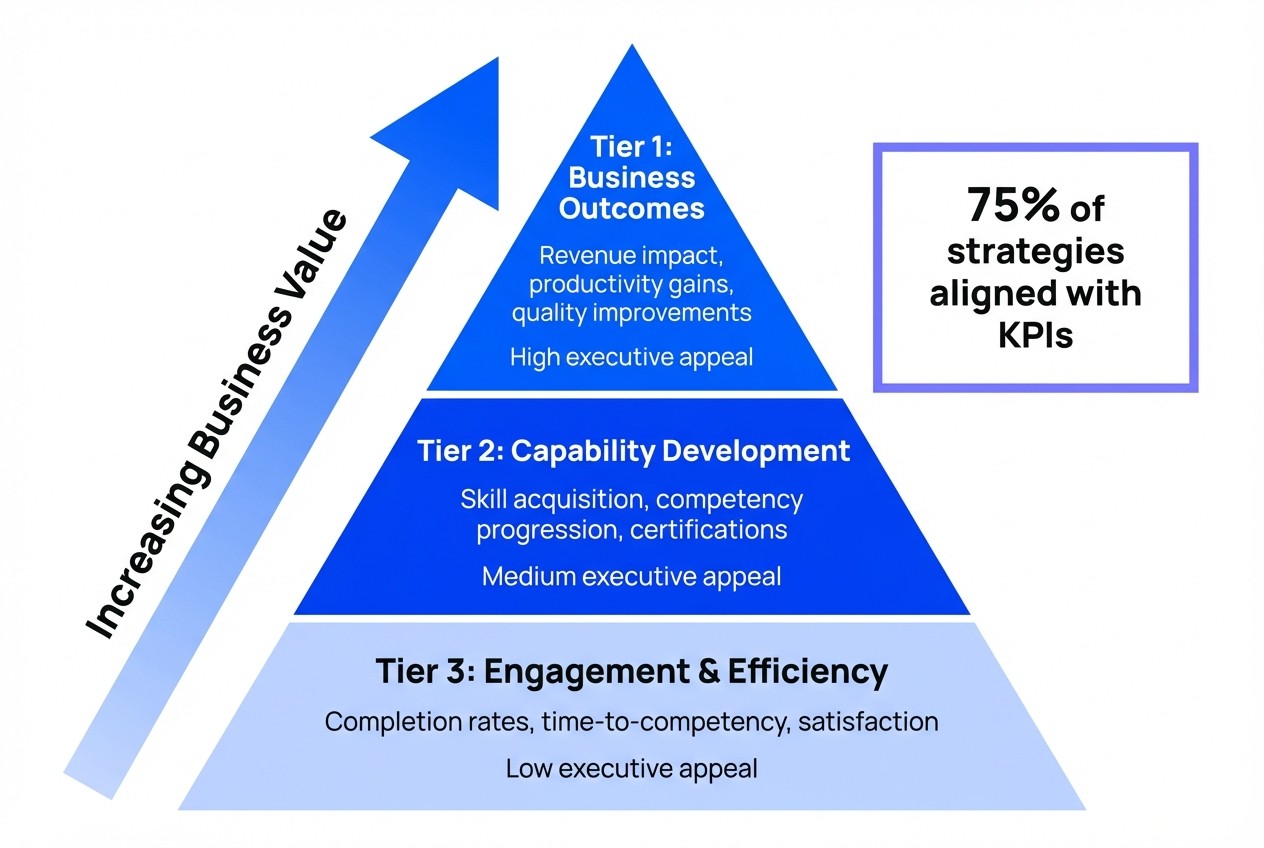
TalentLMS reports 75% of strategies are aligned with KPIs, but which KPIs actually matter? Three tiers provide the answer.
Tier 1 metrics connect directly to business outcomes: revenue impact, productivity gains, quality improvements, time-to-proficiency for new hires. These are the metrics executives care about because they affect the P&L. A sales enablement program that increases average deal size by 12% speaks the CFO's language.
Tier 2 metrics track capability development: skill acquisition rates, competency progression, certification achievement. These matter because they're leading indicators of Tier 1 outcomes. If competency scores improve but business metrics don't, the wrong skills are being developed.
Tier 3 metrics measure engagement and efficiency: completion rates, time-to-competency, learner satisfaction. These are operational indicators that help optimize programs but don't demonstrate business value on their own.
| Metric Tier | Example Metrics | Measurement Method | Executive Appeal |
|-------------|-----------------|-----------------------|------------------|
| Tier 1 | Revenue per rep, defect rates | Business system data | High |
| Tier 2 | Skills assessment scores | Competency evaluations | Medium |
| Tier 3 | Course completion rates | LMS data | Low |
Calculating L&D ROI requires connecting Tier 2 and Tier 3 metrics to Tier 1 outcomes. The formula: (Business Impact - Program Cost) / Program Cost. If a $50,000 training program increases productivity by $200,000, ROI is 300%. ATD benchmarks provide industry comparisons for context.
Effective L&D measurement connects training activities to business outcomes through three tiers: direct business impact metrics, capability development indicators, and operational efficiency measures.
Why Traditional L&D Development Takes Weeks (And How Modern Teams Cut That to Hours)
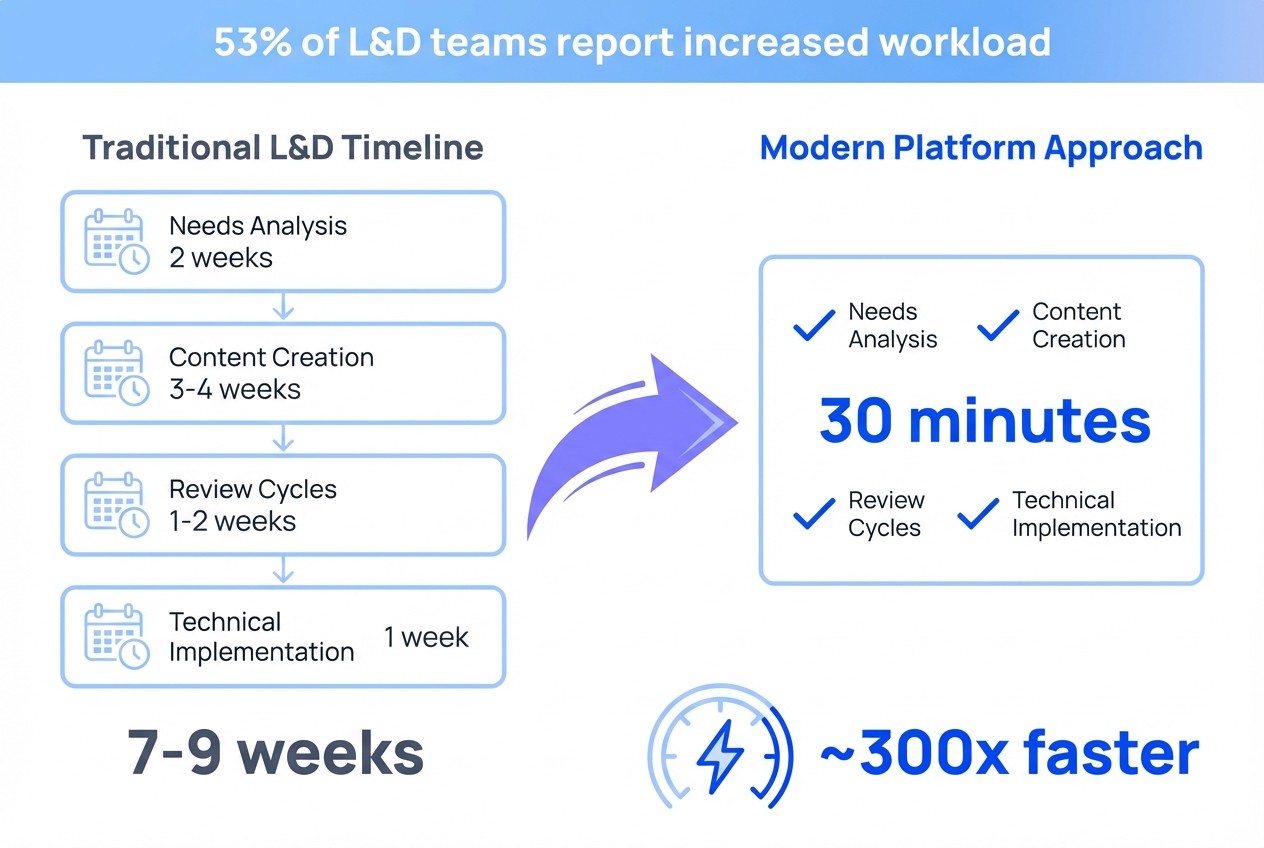
CIPD's finding that 53% of L&D teams face increased workload highlights a resource constraint that traditional development timelines can't accommodate.
The traditional timeline breaks down as: needs analysis (2 weeks), content creation (3-4 weeks), review cycles (1-2 weeks), technical implementation (1 week). That's 7-9 weeks minimum, and often longer when subject matter experts are unavailable or technical issues arise.
Three bottlenecks create the delay. Content creation requires instructional design expertise most organizations lack internally. Subject matter expert availability is limited—the people who know the content best are usually the busiest. Technical implementation involves LMS configuration, SCORM packaging, and testing that requires specialized skills.
Modern platforms compress these cycles by providing pre-built templates, AI-assisted content creation, and streamlined deployment. Platforms like Foxtery exemplify this shift, enabling L&D teams to build and deploy professional training programs in 30 minutes instead of 30 days. This speed-to-implementation directly addresses the workload pressure 53% of L&D teams report facing.
When a new compliance requirement emerges or a product launch demands immediate sales enablement, teams can create, customize, and launch training the same day—eliminating the traditional weeks-long bottleneck. The efficiency gain isn't marginal. It's the difference between reactive and proactive L&D.
Common L&D Strategy Mistakes (And What to Do Instead)
Building strategy in isolation without business leader input guarantees misalignment. L&D teams that develop strategies independently, then present them for approval, miss critical context about business priorities and resource constraints. Instead, involve business leaders from the start—make them co-creators, not reviewers.
Focusing on course completion rates instead of capability development optimizes for the wrong outcome. A 95% completion rate means nothing if participants can't apply what they learned. Instead, measure competency development and on-the-job application.
Implementing too many initiatives simultaneously dilutes impact and overwhelms both L&D teams and learners. Organizations launch 15 training programs, achieve mediocre results on all, and wonder why learning doesn't stick. Instead, sequence initiatives and focus resources on high-impact programs.
Neglecting the implementation-to-execution gap creates the disconnect Corndel identified: 97% of organizations offer AI training while only 39% of employees receive it. Strategy documents describe what should happen. Execution determines what actually happens. Instead, build detailed implementation plans with clear ownership and accountability.
Treating L&D strategy as a one-time exercise rather than a living document ensures obsolescence. Business priorities shift, skill requirements evolve, and learning approaches improve. Instead, establish quarterly review cycles and update strategy based on results and changing needs.
Building Learning Culture: The Strategy Multiplier Nobody Talks About
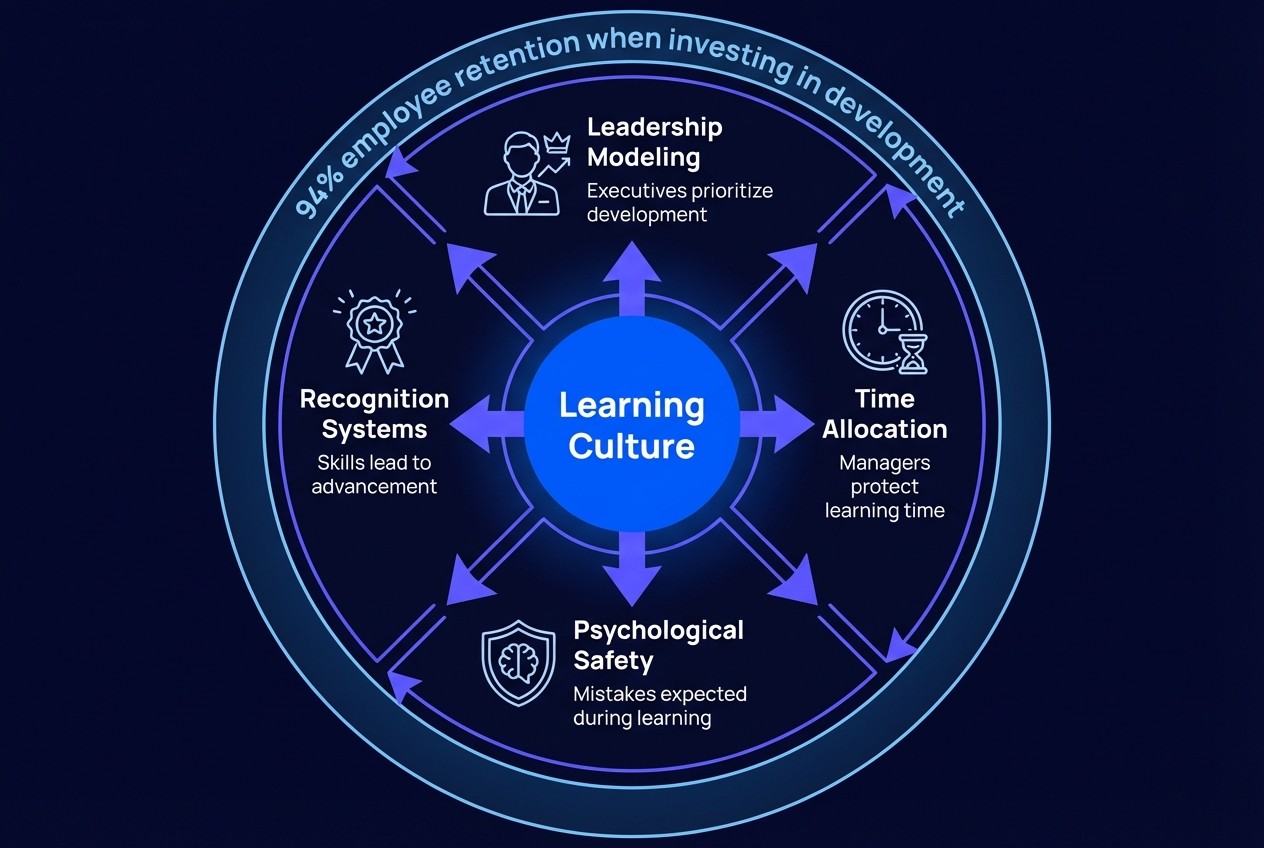
WifiTalents data showing 94% of employees stay longer when companies invest in development reveals retention impact, but the mechanism is culture.
Learning culture is an organizational environment that normalizes continuous development, provides time and resources for learning, and rewards skill acquisition. It's the difference between companies where learning is an HR initiative and companies where it's how work happens.
Four cultural enablers make the difference. Leadership modeling—when executives visibly prioritize their own development, it signals importance. Time allocation—when managers protect learning time rather than treating it as optional, participation increases. Psychological safety—when mistakes during learning are expected rather than punished, experimentation happens. Recognition systems—when skill development leads to advancement, employees engage.
Three quick actions strengthen learning culture immediately. First, add "what did you learn this month" to team meetings, making development a regular discussion topic. Second, allocate dedicated learning time in calendars, treating it as non-negotiable as other meetings. Third, tie promotion criteria explicitly to skill development, not just tenure or performance.
Culture is the foundation for solving the 59% engagement problem Big Think+ identified. Strong learning culture increases engagement, which improves retention, which compounds skill development over time—creating a virtuous cycle.
Conclusion
With 39% of skills becoming obsolete by 2030 and only 7% of workforces ready for the future, L&D strategy has moved from nice-to-have to business-critical. The shift from course catalogs to skills-based approaches, from vanity metrics to business outcomes, and from lengthy development cycles to rapid deployment isn't theoretical—it's how organizations survive accelerating change.
L&D teams face real constraints: increased workload, declining training hours, and engagement challenges that affect the majority of organizations. Strategic efficiency isn't optional. Start with business alignment, focus on high-impact capabilities, and leverage modern tools that compress execution timelines. The organizations that treat learning as strategic infrastructure rather than administrative function are the ones building workforces ready for what comes next.

