
Art Maslow
Founder of Foxtery


Why employee training needs to be rethought
Employee training isn’t becoming expensive because companies invest too much in learning — it’s becoming expensive because traditional employee training programs can’t keep up with how fast businesses change.
This is the reality corporate training now operates in:
Product and process updates happen weekly
Sales, customer success, and operations teams face constant product changes, while employee training still takes weeks to update, leading to outdated courses and financial loss.Skills are changing rapidly due to AI
85% of business leaders expect a surge in skills development needs over the next three years as AI reshapes roles and workflows (Gartner). Manual corporate training models struggle to scale at this pace.Turnover multiplies employee training costs
Fast hiring cycles and expert attrition force organizations to onboard faster while repeatedly rebuilding knowledge.Productivity is declining instead of improving
Despite growing investment in AI tools, falling engagement cost the global economy US $438 billion in lost productivity last year (Gallup), highlighting the performance gap in many training programs.
When employee training is built manually, these forces turn learning into a growing cost center.
AI in employee training is no longer optional. Automated employee training is now essential to keep training current, scalable, and aligned with business needs while cutting costs.
Where traditional employee training loses money
The cost of employee training is driven by slow, manual processes and ongoing productivity losses that increase as organizations grow and change.
Cost driver | What happens | Why it’s costly |
|---|---|---|
Training misaligned with business goals | Learning is created without clear links to priorities or outcomes | Spend on training that does not move business metrics |
Manual course creation and updates | Courses are built and maintained by hand and lag behind change | High L&D and expert effort, delayed updates, slow response to business needs |
Impersonal training | Same content for all roles and skill levels | Time wasted on irrelevant learning |
Expert interruptions | Seniors repeatedly explain the same basics | High-value time diverted from core work |
Low training impact | Courses completed but skills not applied on the job | Spend without performance return |
To make these costs more tangible, here’s an example calculation for a 200-employee company, showing how everyday knowledge gaps translate into real financial loss.
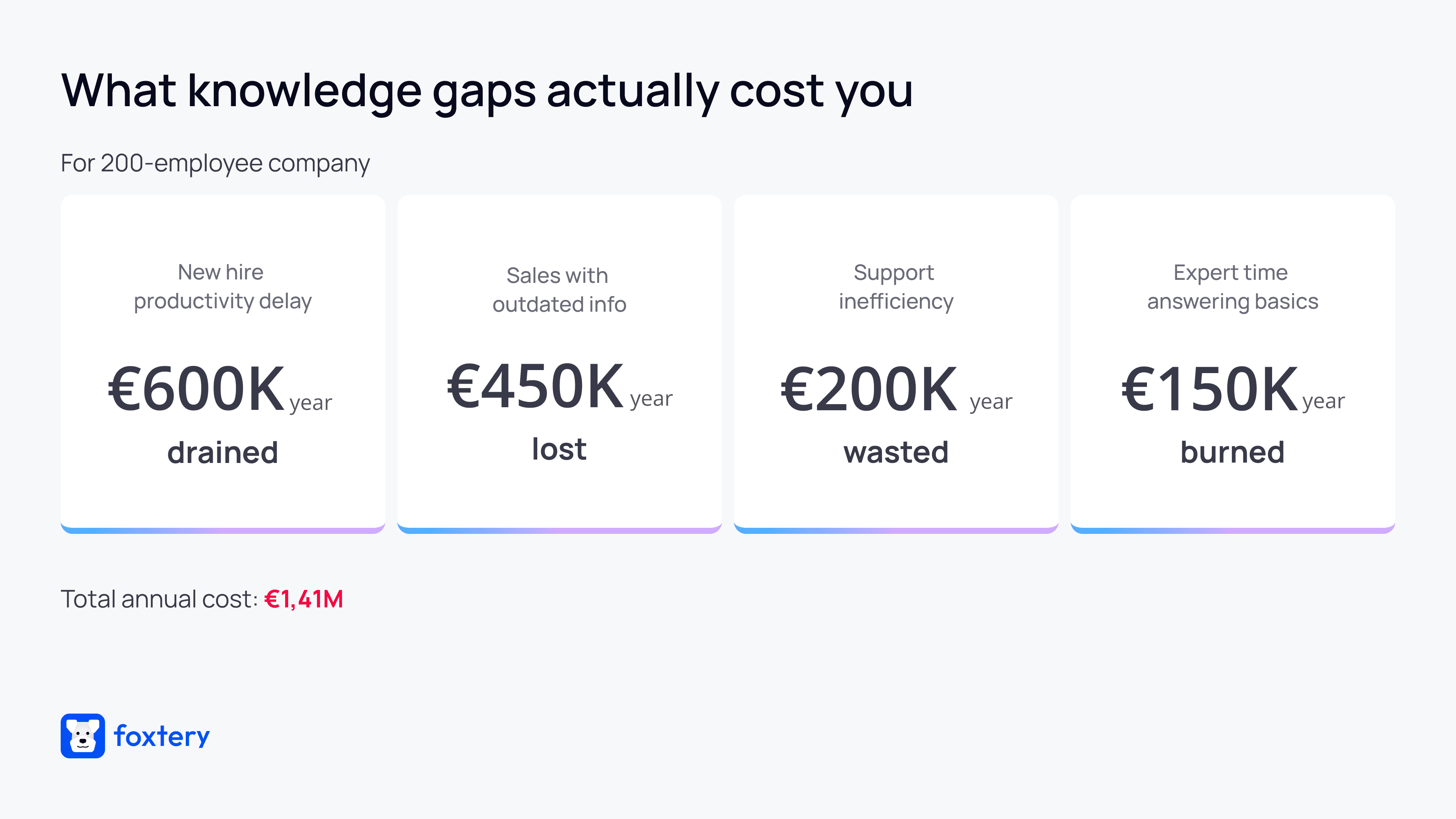
This is why organizations aren’t just looking to optimize employee training anymore.
They’re turning to AI-driven automation to remove the inefficiencies that make training expensive in the first place.
The core ways AI changes the economics of employee training
AI cuts employee training costs by removing the operational friction that makes traditional training slow, expensive, and misaligned with business needs. The impact comes from five concrete levers.
1. Mapping learning directly to skills and business needs
AI links training content to skills, tasks, and proficiency levels, creating a clear connection between what people learn and what the business actually needs them to do.
Typical cost impact:
20–30% reduction in spend on irrelevant or misaligned training
Better prioritization of learning investment
Clearer accountability between training and business outcomes
2. Personalizing training by role and proficiency
AI adapts training to an employee’s role, experience level, and demonstrated knowledge. People spend time only on what they actually need to learn, instead of sitting through generic courses.
This is where employee training stops scaling time spent and starts scaling relevance.
Typical cost impact:
30–50% reduction in time employees spend in training
Higher completion quality without increasing content volume
Less productivity lost to irrelevant learning
3. Automating course production and updates
AI replaces manual course creation and maintenance with a single automated workflow. Existing documents, product updates, and process changes are continuously transformed into training, without restarting the process every time something changes.
Typical cost impact:
60–90% reduction in course production time
50–70% lower cost per course when factoring in L&D, expert, and design time
Near-elimination of recurring update costs for product and process changes
4. Capturing expert knowledge once and scale it
Instead of relying on experts to repeatedly explain the same concepts, AI captures their knowledge and makes it reusable across training, onboarding, and day-to-day learning support.
This reduces one of the most expensive and invisible costs in employee training: senior people doing repetitive teaching instead of high-impact work.
Typical cost impact:
20–40% reduction in expert time spent on repeat explanations
Lower dependency on live sessions and ad-hoc support
Reduced knowledge loss when experts leave
5. Turning training into performance, not just completion
AI continuously checks understanding, adapts explanations, and reinforces weak areas. Training becomes interactive and outcome-driven instead of static and checkbox-based.
This directly reduces the cost of mistakes, rework, and inconsistent execution caused by knowledge gaps.
Typical cost impact:
Fewer errors and less rework downstream
Faster time to productivity for new hires and role changes
Higher ROI from existing training investment
Putting it together
Individually, these savings matter. Combined, they change the economics of employee training entirely. Costs stop scaling with headcount and change frequency and start scaling with actual capability and performance.
Integrate AI into employee training step-by-step
Once the cost levers are clear, the next challenge is execution.
AI delivers results only when it’s introduced deliberately and connected to how people already work. Here’s a practical path companies follow to add AI to employee training without breaking existing systems.
Step 1: Anchor learning to business goals and map the skills that drive them
Effective AI-driven employee training does not start with content or courses. It starts with business outcomes.
AI helps translate business goals into learning priorities by:
Breaking goals (for example, faster onboarding, higher sales win rates, fewer support escalations) into the skills and tasks that directly influence them
Identifying which skills matter most right now as products, processes, and strategy change
Continuously updating skill priorities as demand evolves
This is where skill mapping becomes a business tool rather than an HR exercise.
A good example of this is how EPAM Systems approaches skills. In a presentation shared by Sandra Loughlin, she shows how EPAM uses skills as the common language between business priorities, day-to-day work, learning, and performance. This makes it possible to focus training on real gaps teams are facing, rather than relying on static role descriptions.
[li 7387484837525336064]
What to do in practice:
Start with 2–3 business goals that matter this quarter
Identify the skills and tasks that most directly affect those goals
Use AI to help enrich, validate, and update skill signals over time
Step 2: Use an AI course creator to automate training creation and updates
Once skills are tied to business goals, AI can translate company knowledge into training quickly and keep it current automatically.
With an AI course creator, Foxtery:
Existing documents, SOPs, and product updates are turned into training in minutes
Content adapts to role and proficiency instead of producing one generic course
Courses can be published directly into an existing LMS, without migrations or new learner workflows
If you’ve never built courses with AI before, we have a practical guide on how to make courses with Foxtery, showing how course production and updates drop from weeks to minutes.
The short video below shows how AI turns course creation into a matter of minutes when using Foxtery.
Step 3: Deliver learning inside the flow of work
To change behavior, learning needs to show up where work happens.
This is why many L&D experts now agree that microlearning embedded into daily workflows is far more effective than relying on standalone courses alone.
In practice, AI-powered learning can be:
Delivered directly in Slack, Microsoft Teams, or Telegram
Triggered by real events such as product releases, process changes, or repeated mistakes
Structured as short explanations, scenarios, or reminders rather than full courses
This keeps learning relevant, timely, and closely connected to real decisions.
Step 4: Use AI to check knowledge and support employees on demand
AI-driven employee training doesn’t stop at content delivery. It actively checks understanding and supports recall.
AI knowledge assistants:
Ask contextual questions during or after learning
Detect gaps in understanding early
Re-explain concepts in simpler terms when needed
Answer questions on demand using the company’s knowledge base
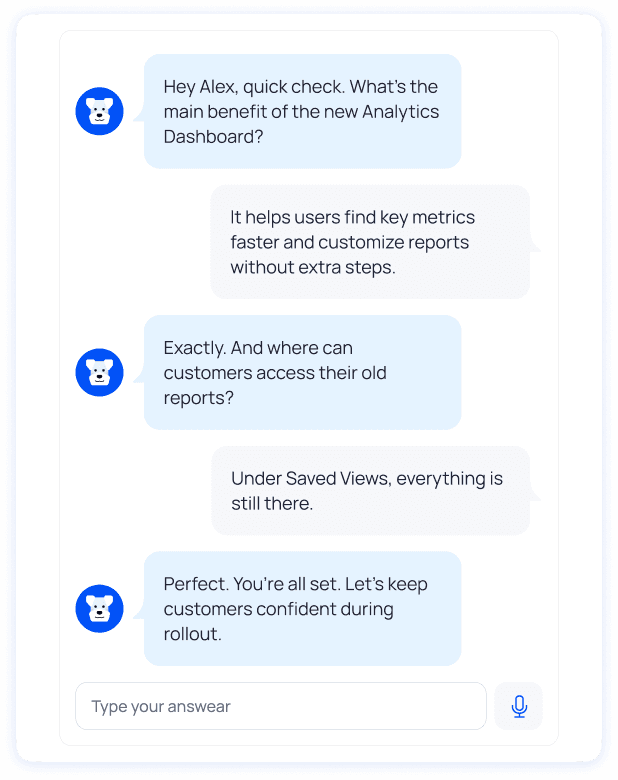
Instead of relying on completion rates or end-of-course quizzes, AI continuously validates whether people actually understand what they need to do — reducing silent knowledge gaps and expert interruptions.
When building courses with Foxtery, you can also automatically create an AI knowledge bot that checks understanding, reinforces key concepts, and supports employees when questions come up.
Step 5: Close the loop with performance feedback and continuous adjustment
To keep employee training aligned with business needs, teams connect learning data to existing performance metrics and use AI to identify where adjustments are needed.
In practice, this looks like:
Pulling outcome data from business systems such as CRM, support, or QA tools
Comparing performance before and after training to spot meaningful patterns
Using AI to flag gaps, suggest reinforcement, or surface ineffective training
Letting L&D and business owners decide what to adjust next
AI reduces the manual effort required to analyze results and spot misalignment, while humans remain responsible for decisions and priorities.
What AI-driven employee training delivers to the business
When employee training is slow, manual, and disconnected from the business, costs appear across the organization. They do not always show up in the learning budget, but they affect productivity, revenue, and risk.
AI changes this by aligning training with how the business actually operates and where value is created or lost.
In practice, this leads to:
Faster onboarding
New hires reach productivity sooner because training is ready on day one and adapts as roles change.Sales and customer success aligned with product updates
Training updates automatically when products or processes change. Teams stay current and avoid lost deals and customer confusion.Reduced dependency on experts
Knowledge is captured once and reused at scale. Senior employees spend less time repeating explanations and more time on high-impact work.Stronger compliance and risk training
AI checks understanding continuously. Errors, incidents, and audit pressure are reduced.Less time spent on irrelevant learning
Personalization ensures employees focus only on what they need to learn. Productivity improves as training time decreases.Clear connection between learning and business results
Training priorities adjust based on performance signals. L&D stays aligned with real business goals.
AI changes employee training from a slow, manual cost center into a system that moves at the speed of the business. Costs drop because learning is no longer rebuilt, repeated, or ignored. It stays current, relevant, and accountable to results.
For organizations dealing with constant change, this is not an optimization. It is a structural shift.

