
Art Maslow
Founder of Foxtery


In 2026, knowledge transfer is about speed. How fast can your teams apply knowledge, adapt it to changing conditions, and share it across the organisation?
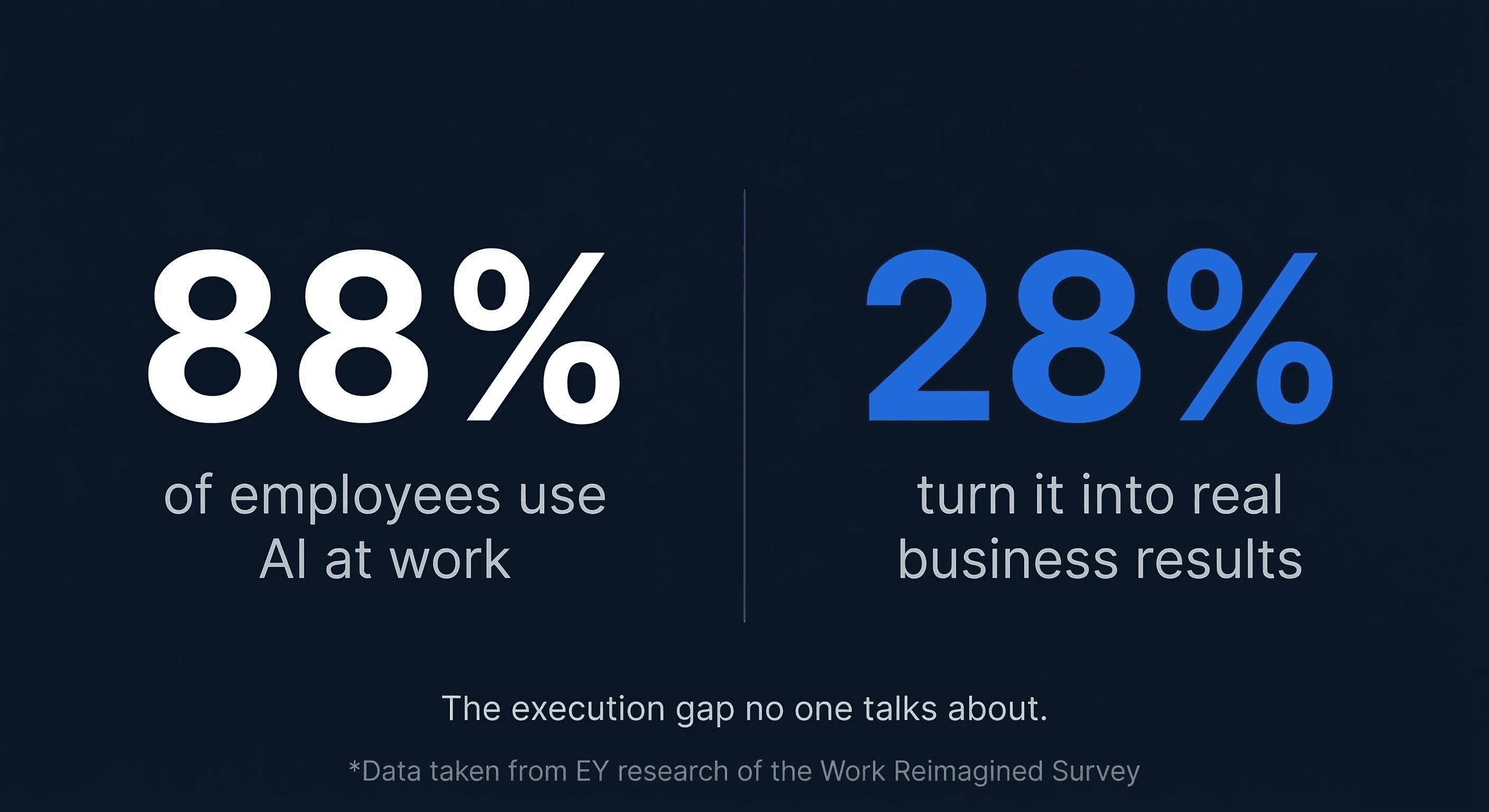
88% of employees already use AI at work, yet only 28% of organisations turn that usage into meaningful business results. That gap shows up when teams experiment with tools but cannot repeat successful workflows, explain decisions, or ramp new hires without constant hand-holding.
Most companies still rely on scheduled training, static documentation, and one-time onboarding. Meanwhile, roles evolve and skills change faster than traditional learning cycles can respond.
This guide explains what modern knowledge transfer looks like in 2026 and gives you a practical framework to build a system that keeps pace with change.
What is knowledge transfer? (and why the definition just changed)
Knowledge transfer used to mean moving expertise from one person to another. A senior employee trains a junior one. Simple, linear, finite. That definition is obsolete.
In 2026, knowledge transfer is a continuous, bidirectional cycle embedded in the flow of work. It operates as an ongoing system rather than a one-time event. It spans formal training, peer-to-peer sharing, reverse mentoring, real-time problem solving, and AI-assisted learning loops. Traditional training delivers information. Modern knowledge transfer cultivates capability.
39% of workers' core skills are expected to change by 2030. That's four years away. Nearly 40% of institutional knowledge your organization holds today will be outdated. If your knowledge transfer system operates on annual cycles, you're already behind.
Traditional knowledge transfer | Modern knowledge transfer |
|---|---|
|
|
The three pillars of effective knowledge transfer in 2026
Effective knowledge transfer in 2026 rests on three interdependent pillars. Together, they prioritize speed, humanize learning in an AI-first world, and remove leadership bottlenecks.
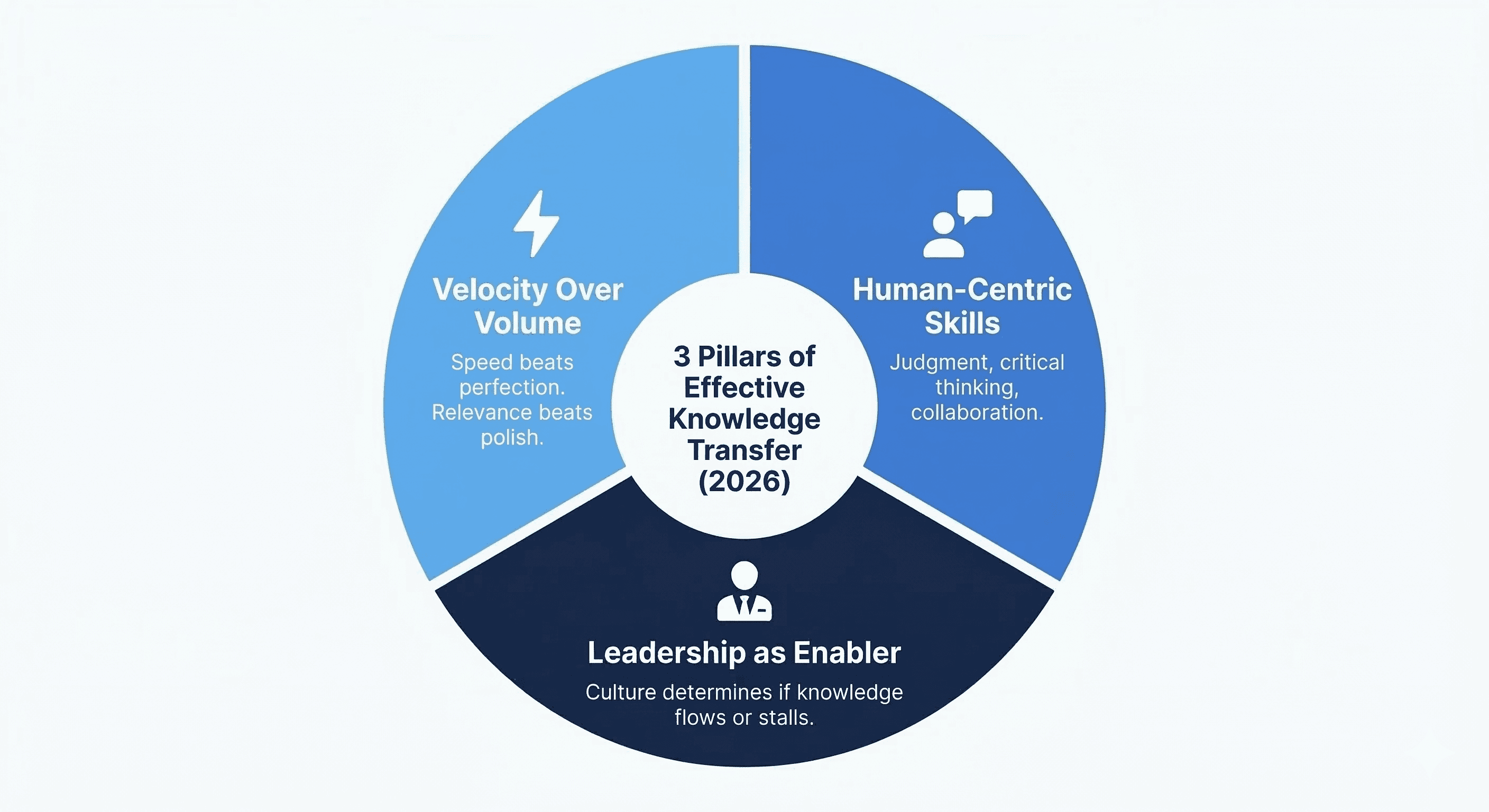
Pillar 1: Velocity over volume
Required skills are changing 66% faster in AI-exposed occupations. If your training development takes three months, the skills you're teaching may already be shifting.
The traditional model built around comprehensive courses, polished videos, and extensive documentation moves too slowly for today’s pace of change. Speed matters more than volume.
What just-in-time knowledge transfer looks like:
Microlearning modules: Five-minute videos demonstrating common workflows, accessible via Slack or Teams
Moment-of-need resources: One-page guides embedded in tools employees already use
Peer knowledge channels: Dedicated channels where employees share tips in real-time
AI-assisted documentation: Automated capture of successful approaches that become searchable articles
Instead of building a two-hour CRM course, record a five-minute walkthrough of the three workflows your sales team uses every day. Update it as often as needed.
That requires letting go of perfection. In fast-moving companies, relevance beats polish. A useful resource today creates more impact than a perfect asset next quarter.
To support this, you need a system that keeps knowledge connected and current. With Foxtery AI course builder, you create a structured Knowledge Map that brings documents, videos, and expert input into one living source of truth. All the trainings are generated from that shared foundation and automatically updated when the knowledge base changes.
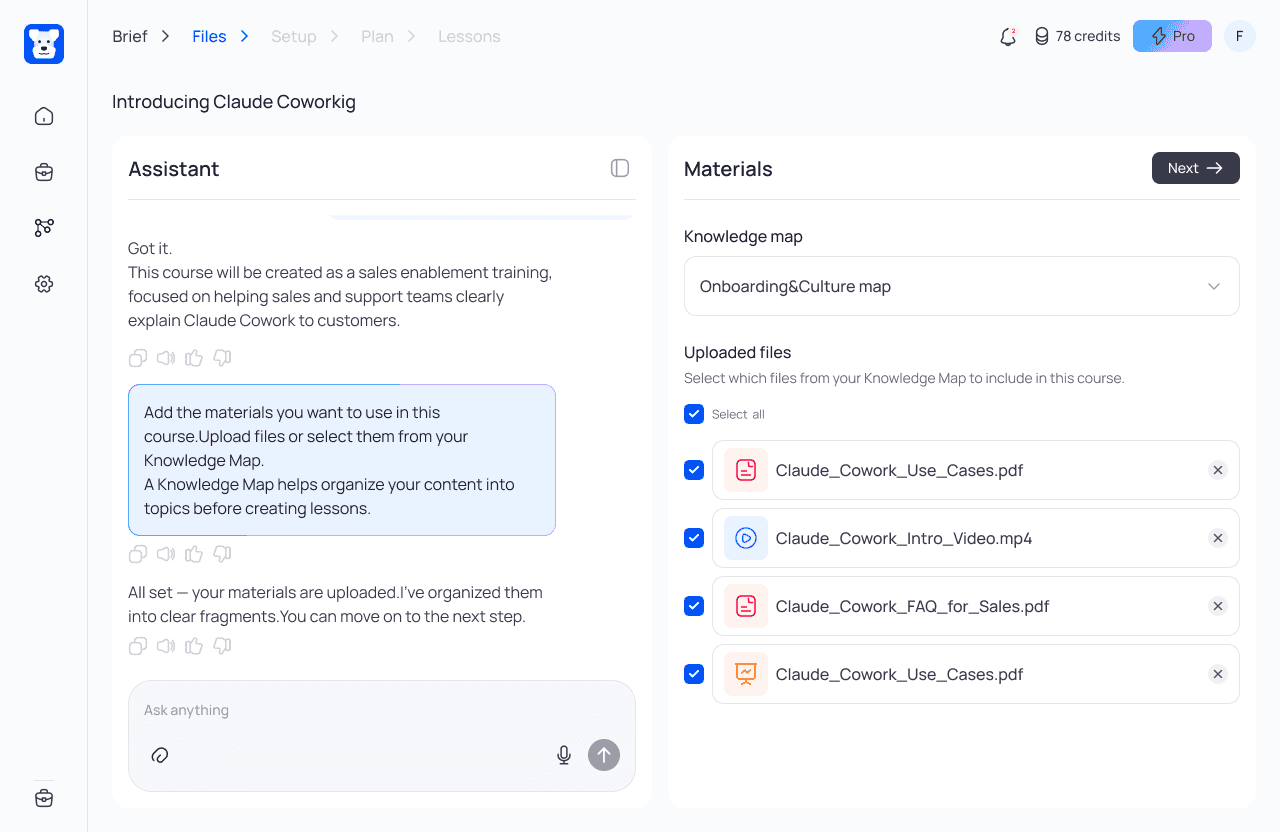
Add new information once, and it flows across all the courses. Instead of constantly rebuilding content, you maintain a dynamic knowledge system that evolves with the business.
If you have never created a course with an AI course builder before, here's a simple five-minute guide to help you get started.
Pillar 2: Human-centric skills in an AI-first world
As AI handles more execution, the most valuable knowledge to transfer is distinctly human.
73% of Talent Acquisition leaders rank critical thinking as their #1 recruiting priority, while AI skills rank 5th. The market values judgment over tool proficiency.
AI can draft the email. Humans must decide whether to send it.
AI can analyze data. Humans must interpret what it means for the business.
The human-centric skills that matter most in 2026:
Critical thinking: Evaluating AI outputs, identifying flawed assumptions, asking better questions
Change management: Helping teams adapt to new processes and tools
Stakeholder management: Navigating organizational politics, building consensus
Ethical decision-making: Determining when automation is appropriate
Collaboration: Working effectively across hybrid teams and time zones
Transferring these skills is harder than teaching technical proficiency. These capabilities require coaching, practice, feedback loops, and real-world application.
Effective transfer methods:
Role-playing scenarios: Practice difficult conversations and ethical dilemmas
Case study analysis: Examine situations where judgment calls went right or wrong
Mentorship programs: Pair experienced employees with those developing capabilities
Facilitated reflection: Structured debriefs after projects to extract lessons learned
These methods work because human-centric skills are built through practice, not theory. Reading about stakeholder management is not the same as handling resistance in a real conversation. Watching a case study does not replace making a judgment call under pressure.
The challenge is scale. Practice usually depends on senior colleagues reviewing cases, giving feedback, and repeating the same coaching.
Foxtery AI Conversational Simulator turns real business situations into structured practice. Teams upload internal conversations, transcripts, or documentation, and the system adapts scenarios to their specific context. Employees then train in an AI-powered role play environment that develops judgment, communication, and decision-making.
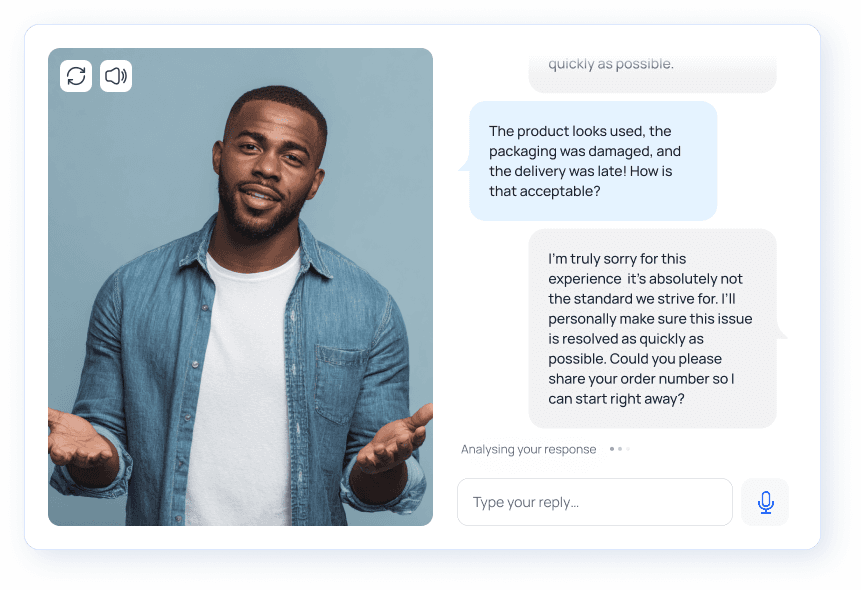
Instead of relying only on manual coaching, organisations create repeatable, realistic simulations that strengthen human skills at scale.
Pillar 3: Leadership as the transfer bottleneck
64% of CHROs say their leaders lack the mindset to guide people through continuous change. This signals a deeper organizational weakness that affects performance, culture, and long-term adaptability.
Knowledge transfer fails when leaders don't model learning, don't create psychological safety, or don't reinforce new behaviors. You can build the perfect training system, but if a manager says "we don't have time for this," the system collapses.
A manager who views training as "time away from real work" signals that learning isn't valued. Employees pick up on that instantly.
What leaders need to facilitate effective knowledge transfer:
Change management skills: Guiding teams through transitions without triggering resistance
Coaching capability: Asking questions that help employees discover solutions
Psychological safety creation: Building environments where it's safe to admit knowledge gaps
Peer-to-peer facilitation: Enabling knowledge flow across the team
80% of organizational transformation success depends on HR's ability to retrain management. Not frontline workers. Management.
This requires a fundamental shift in how L&D teams allocate resources. Instead of building 100 courses for employees, build 10 for leaders — focused on change leadership, coaching, and facilitation.
Tactical interventions:
Leadership workshops on change management and psychological safety
360-degree feedback focused on learning facilitation behaviors
Manager coaching on development conversations
Recognition systems that reward knowledge-sharing behaviors
Common knowledge transfer mistakes (and how to avoid them)
Even well-intentioned L&D teams fall into predictable traps. Here are the four most damaging mistakes and how to avoid them.
Mistake 1: Treating transfer as a one-time event
The Problem: Organizations design knowledge transfer as a single training session, assuming knowledge will "stick." Employees forget 70% of new information within 24 hours without follow-up.
The Fix: Build spaced repetition into your system. Use follow-up nudges at 3 days, 2 weeks, and 30 days. Create refresher sessions at 60 and 90 days. Make resources searchable so employees can revisit them.
Mistake 2: Focusing only on technical skills
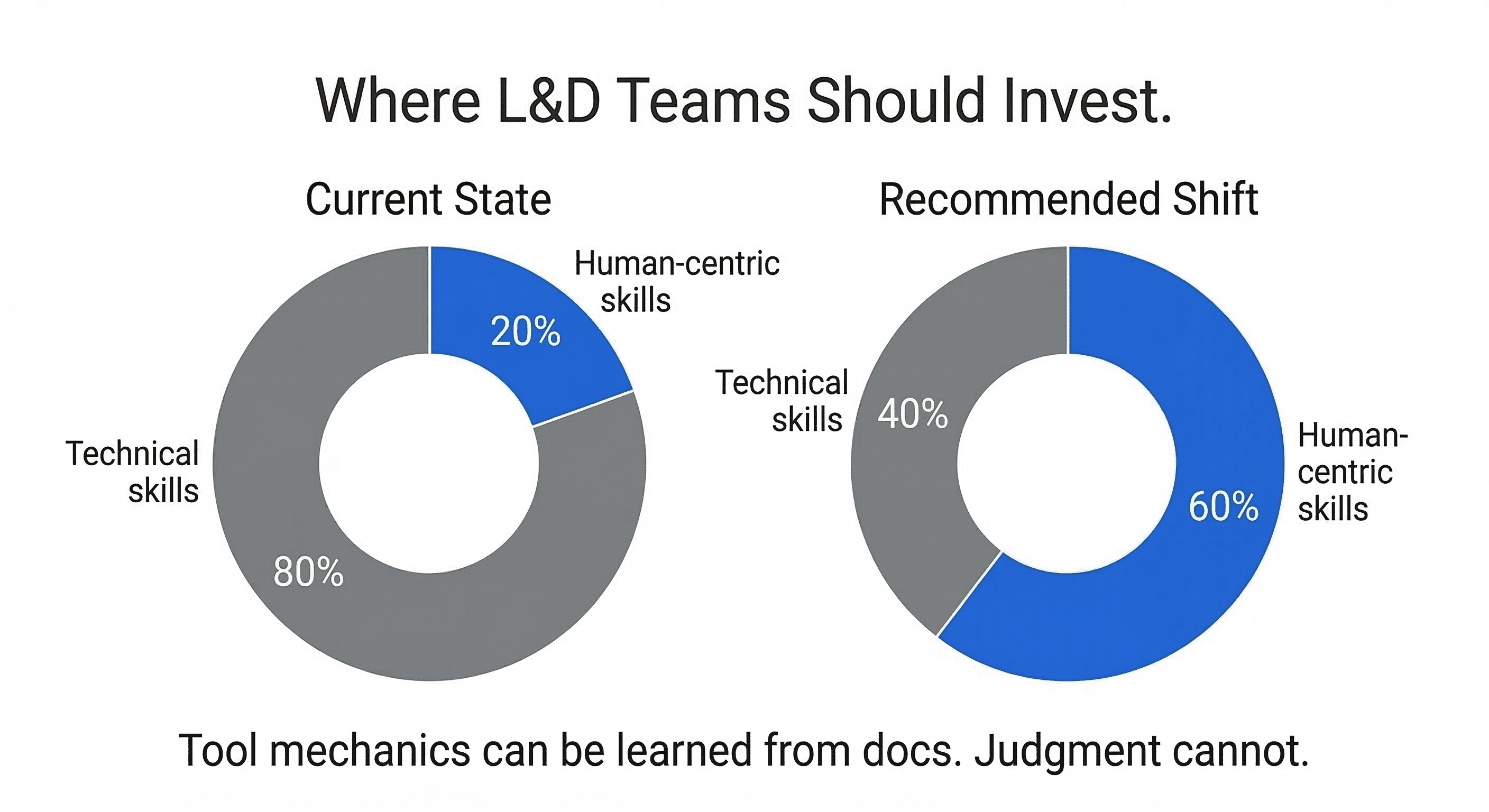
The Problem: L&D teams spend 80% of budget teaching how to use tools and only 20% on when and why to use them. Technical proficiency without judgment leads to the 88% vs. 28% gap.
The Fix: Flip the ratio. Spend 60% on human-centric skills and 40% on technical training. Assume employees can learn tool mechanics through documentation. Invest in building judgment and decision-making frameworks.
Mistake 3: Building for in-office teams in a hybrid world
The Problem: Many systems rely on in-person shadowing and spontaneous mentorship. These break down in hybrid environments, creating knowledge silos.
The Fix: Design for asynchronous-first, remote-first transfer. Record processes as videos. Build searchable knowledge bases. Create virtual communities of practice. Assume your best knowledge holder and newest employee are never in the same room.
Mistake 4: Measuring completion instead of application
The Problem: Most L&D teams still track completion rates and quiz scores. None of these tell you whether employees are applying knowledge or improving outcomes.
The Fix: Move to impact-based measurement. Track time-to-competency. Monitor retention rates. Survey managers 30 days post-training: "Is this person applying what they learned?"
Building your knowledge transfer system: 4-phase implementation plan
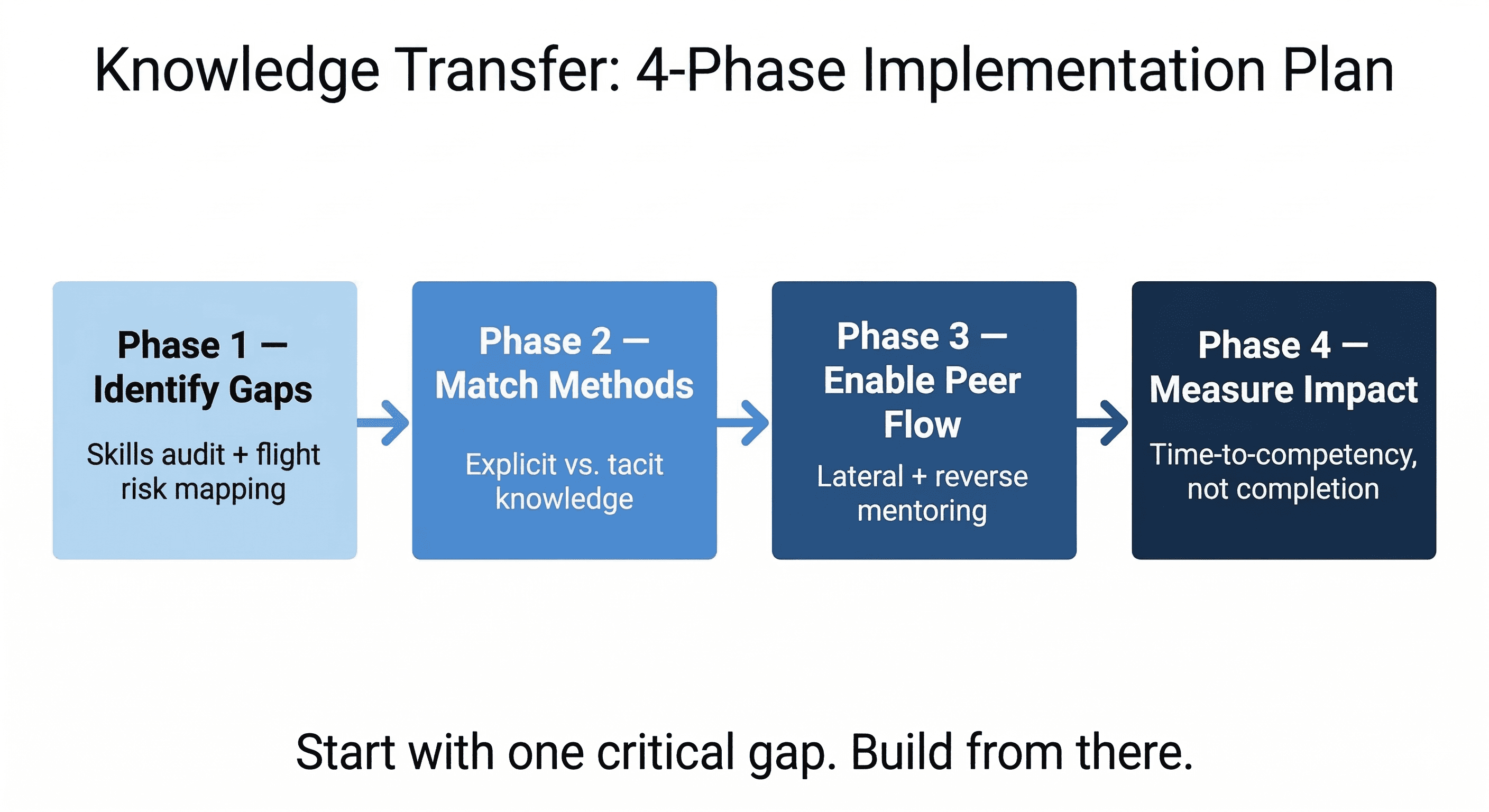
Use this four-phase framework to move from strategy to execution. Each phase includes tactical steps you can implement starting today.
Phase 1: Identify critical knowledge gaps
You can't transfer knowledge effectively if you don't know what's missing. Start with a rigorous audit.
Steps to identify gaps:
Conduct a skills inventory: Survey employees and managers to identify current capabilities and desired future states
Prioritize based on business impact: Focus on skills that directly affect revenue, customer satisfaction, or operational efficiency
Identify knowledge flight risk: Map which employees hold critical expertise and assess their likelihood of departure
Analyze performance data: Look at where teams are struggling — high error rates, long time-to-competency, or frequent escalations
Example: If your customer success team averages 45 days to first resolution for complex issues, but your top performer does it in 15 days, you have a 30-day knowledge gap. That performer holds tacit knowledge that needs systematic transfer.
Phase 2: Choose the right transfer method for each knowledge type
Not all knowledge transfers the same way. Match your method to the knowledge type.
Explicit knowledge (facts, processes, procedures) | Tacit knowledge (judgment, intuition, context) |
|---|---|
|
|
Example: For "how to use the new CRM," create a video library with searchable timestamps. For "how to handle a difficult client conversation," pair junior employees with senior mentors for live observation and debrief sessions.
Context matters: Remote teams need asynchronous resources. In-office teams can leverage spontaneous learning moments. Hybrid teams need both.
Phase 3: Enable peer-to-peer and upward transfer
The best knowledge transfer systems don't rely on top-down instruction. They enable lateral and upward knowledge flow.
Tactics for peer-to-peer transfer:
Create knowledge-sharing channels: Dedicated Slack or Teams channels where employees share tips and solutions
Lunch-and-learn sessions: Informal presentations where employees teach each other
Internal wikis: Collaborative documentation platforms where anyone can contribute
Recognition programs: Reward employees who actively share knowledge
Reverse mentoring: Younger employees often have cutting-edge knowledge about new tools and emerging trends. Create formal reverse mentoring programs where junior employees teach senior leaders.
Example: At one tech company, junior developers host monthly "Tech Talks" teaching senior leaders about emerging AI tools. This transfers knowledge upward and gives junior employees visibility.
Incentivize sharing: Build knowledge-sharing behaviors into performance reviews. Make "helps others learn" a formal competency. What gets measured and rewarded gets repeated.
Phase 4: Measure what matters
Completion rates only show whether people finished a course and where they dropped off. They do not tell you whether knowledge was applied, skills improved, or performance changed. If knowledge transfer is meant to drive real capability, your metrics need to go beyond tracking attendance and progress bars.
Move beyond completion metrics to impact metrics:
Time-to-competency: How long does it take a new hire to perform at full productivity?
Retention rates: Are employees who receive strong onboarding more likely to stay?
Productivity gains: Are trained employees outperforming untrained peers?
Manager feedback: Survey managers 30 and 60 days post-training
Application rate: What percentage of trained employees are using the new skills?
Use data to iterate: If completion rates are high but application rates are low, your content isn't practical enough. If time-to-competency isn't improving, your transfer methods aren't effective.
Tools to leverage: Your LMS analytics, HRIS performance data, manager surveys, and A/B testing between trained and untrained cohorts. The data exists. Most L&D teams just aren't looking at the right metrics.
The ROI of strategic knowledge transfer
Knowledge transfer directly impacts performance, retention, and revenue, making it a strategic investment with measurable returns.
Retention: 90% of organizations cite learning opportunities as the #1 retention strategy. Replacing an employee costs 50-200% of their annual salary. If effective knowledge transfer reduces turnover by even 10%, the ROI is immediate.
Productivity: When organizations move from casual AI usage to structured capability building, productivity improves in measurable ways. The gap between widespread AI access and real business outcomes comes down to how effectively knowledge is transferred, applied, and reinforced in daily work.
Competitive advantage: Competitors can copy your product ideas and marketing strategy. They cannot easily copy the learning system behind your execution. When you use modern AI technologies to capture and distribute knowledge faster than others, your organization improves continuously and pulls ahead over time.
Risk mitigation: When critical knowledge holders leave, organizations lose institutional expertise. Systematic knowledge transfer protects against this flight risk.
The question isn't whether you can afford to invest in knowledge transfer. It's whether you can afford not to.
Conclusion: Knowledge transfer as infrastructure
Knowledge transfer determines how well strategy turns into execution. Every product update, customer insight, or process change either becomes shared capability or stays trapped in silos.
The advantage does not come from producing more training. It comes from building a system that captures expertise, translates it into practice, and updates as the business evolves.
Start with one critical gap. Build the right transfer method around it. Measure application, not completion.
If you want to operationalize knowledge transfer at speed, Foxtery helps teams build structured knowledge maps and generate adaptive training in minutes, creating a living system that evolves with your company.

