
Art Maslow
Founder of Foxtery


HR directors face a paradox: 75% of organizations updated their leadership programs and increased spending, yet most report seeing no meaningful results. Meanwhile, companies with strong leadership training are 8.8x more likely to have quality leadership and 9x more likely to outperform financially.
The problem shows up in retention data and manager readiness scores. Only 15% of employees feel their training prepares them for leadership roles, and 74% of leaders report feeling unprepared to manage organizational change. Organizations spend hundreds of thousands annually on programs that don't translate to behavior change or business outcomes.
This article provides the diagnostic framework and measurement approach HR directors need to build programs that actually move retention and performance metrics.
Why most leadership training budgets produce zero results
The disconnect between investment and outcomes stems from a fundamental execution gap. Gartner's 2024 research found that despite 75% of organizations updating programs and increasing budgets, effectiveness hasn't improved. The contrast with high-performing organizations is stark: those with structured leadership development see 8.8x better leadership quality and 9x stronger financial performance.
Only 15% of employees feel training prepares them for leadership.
The main problem is the design of those trainings:
generic curriculum that doesn't address specific management scenarios fails to transfer skills.
programs that take 6+ weeks to launch miss the critical window when new managers need support most.
no measurement infrastructure that tracks behavior change.
Real cost of ineffective leadership development
Turnover data quantifies the business impact. Organizations investing in leadership development experience 25% lower turnover, which translates to substantial savings when calculated against replacement costs. For a 500-person company with 15% annual turnover, reducing that to 11.25% saves approximately $375,000 annually at $50,000 per replacement.
Variable | Value | Notes |
|---|---|---|
Total headcount | 1,000 | Enterprice-scale org |
Baseline annual turnover rate | 15% | Industry median |
Annual leavers (before) | 150 people | 1,000 x 15% |
Turnover reduction from leadership dev | 25% | Research benchmark |
New turnover rate | 11.25% | 15% x (1 - 25%) |
Annual leavers (after) | 112 people | 1,000 x 11.25% |
Employees retained | 38 people | 150-112 |
Replacement cost per employee | $75,000 | Enterprise avg: ~75% of $100K salary |
Annual turnover cost: BEFORE | $11,250,000 | 150 x $75,000 |
Annual turnover cost: AFTER | $8,437,500 | 112 x $75,000 |
Annual savings | $2,812,500 | 38 x $75,000 |
The budget reality compounds the problem. Organizations allocate a median 15% of HR budget to learning and development, with 38% of that spent on external training. For an organization spending $500,000 annually on leadership training with no retention improvement, the opportunity cost exceeds $125,000 in preventable turnover alone.
Variable | Value | Notes |
|---|---|---|
Total annual leadership training budget | $1,500,000 | ~$1,500 per employee (enterprise benchmark) |
HR budget allocation to L&D (median) | 15% | Industry median |
External training spend (38% of L&D) | $570,000 | $1,500,000 x 38% |
Internal training spend | $930,000 | Remaining 62% |
Retention improvement achieved | 0% | Worst case (no improvement scenario) |
Preventable turnover savings left on table | $2,812,500 | See previous calculations |
Opportunity cost of ineffective training | $2,812,500 | Savings available but not captured |
Opportunity cost ratio | 1.88x | $2.8M loss vs $1,5M spend |
The change management crisis adds another dimension. 74% of leaders feel unprepared to manage organizational change, creating risk during restructuring, technology adoption, or market shifts. Leadership training that doesn't address change readiness leaves organizations vulnerable precisely when strong leadership matters most.
Source | Annual value |
|---|---|
Turnover savings | $2,812,500 |
Opportunity cost recovered | $2,812,500 |
Change initiative risk reduction | $500,000 |
Total annual impact | $6,125,000 |
That $6.1M number is you can bring to the CFO to justify the L&D budget - and the number Foxtery helps you to capture.
What separates effective programs from expensive failures
Speed to impact determines whether training reaches managers when they need it. Traditional program development takes 6-12 weeks. By month three, new managers have already formed habits - good or bad.
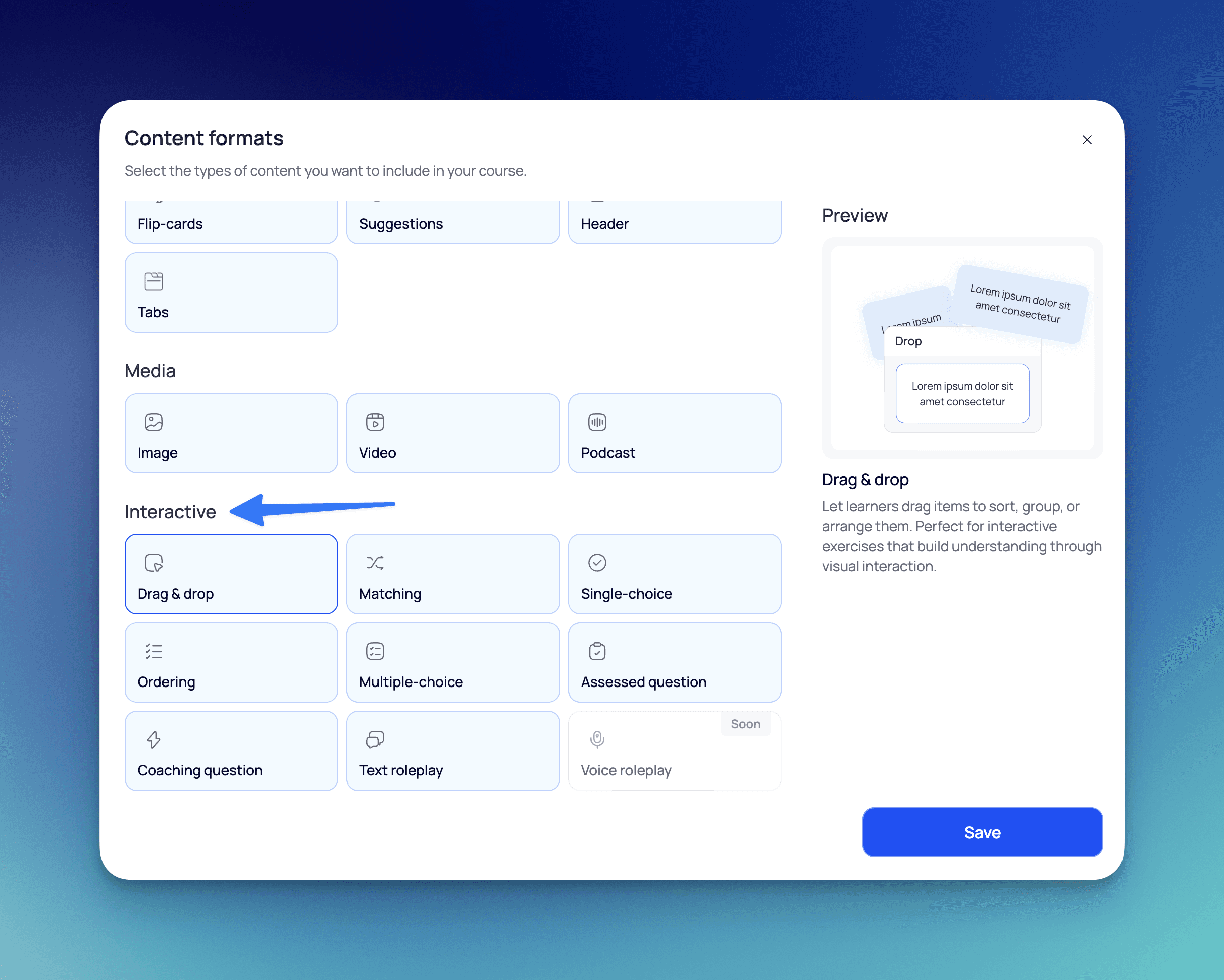
Modern platforms like Foxtery help HR teams to launch professional leadership training in under 30 minutes. Just add details about your course goals & its target audience > share any materials you have > get your course generated. Inside Foxtery, you're able to include 40+ interactive formats such as flash cards, drag&drop, multiple choice, text role-play, matching, etc.
Measurement infrastructure separates programs that work from those that don't. Completion rates don't predict leadership effectiveness. Successful programs track behavior change: 1-on-1 frequency, feedback quality, team retention, promotion readiness. Organizations set baseline metrics before training, then measure at 30, 60, and 90 days to identify what's actually changing.
Relevance to role matters more than curriculum breadth. Generic leadership content fails because it doesn't address the specific scenarios managers face. A retail store manager needs different skills than a software engineering lead. Effective training customizes scenarios and examples to organizational context, plus, maintains foundational frameworks.
Reinforcement models determine skill retention. One-time workshops don't stick. Programs with ongoing application and feedback show 3x better retention of skills.
How to allocate leadership training budget
Budget allocation follows organizational benchmarks and leadership level. Organizations allocate a median 15% of HR budget to L&D, with 38% of that spent on external training. For a 500-person company with $1 million HR budget, that's $150,000 for L&D, with $57,000 allocated to external leadership programs.
Distribution by leadership level should follow impact and volume:
40% for new managers (highest volume, greatest impact on retention),
35% for mid-level leaders (driving team performance),
25% for executives (strategic decision-making).
The budget stability trend provides planning confidence. 90% of L&D budgets stayed the same or increased compared to the previous year, and 75% of organizations now have L&D representation on senior leadership teams.
Build vs. buy decision framework
Organizational size and urgency determine the optimal approach. Building custom programs makes sense for organizations with 1,000+ employees, mature L&D teams, and highly specialized leadership competencies. The investment (typically $80-120K over 12-16 weeks) pays off when content requires deep organizational customization.
Buying external programs works for organizations under 1,000 employees, limited L&D staff, or urgent needs like a wave of new managers or restructuring. External platforms cost $15-40K and launch in 1-4 weeks. It provides 4x faster deployment at one-third the cost. The speed advantage matters when managers need support immediately.
Enterprise (1,000+ employees) | Mid-Market (Under 1,000 employees) | With Foxtery | |
|---|---|---|---|
Recommended approach | Build custom program | Buy external program | Build custom - at external speed |
Best for | Mature L&D teams with specialized competency needs | Limited L&D staff or urgent training needs | Any team size, any urgency level |
Typical investment | $80,000 – $120,000 | $15,000 – $40,000 | From $0 - no agency, no vendor |
Time to launch | 12 – 16 weeks | 1 – 4 weeks | 30 minutes |
Deployment speed | Baseline | 4x faster | 100x faster than custom build |
Relative cost | Baseline | 3x cheaper | Up to 10x cheaper than custom |
Customization depth | High | Moderate | High - built from your own docs, SOPs, and internal knowledge |
When it makes sense | Deep org-specific content, large cohorts, long-term program | New manager wave, restructuring, immediate need | Both: custom content at the speed of off-the-shelf |
Main risk | High upfront cost, long lead time | Less organizational context, generic content | None of the above |
The hybrid approach combines both strengths. Platforms like Foxtery allow HR teams to deploy foundational leadership content immediately. The platform customizes scenarios and examples for organizational challenges. The best part - it delivers top-notch course within 30 minutes!

How to measure leadership training ROI
Leading indicators measured at 30 days predict long-term success: 1-on-1 frequency (target: weekly), feedback instances (target: 3+ per week), manager confidence scores (baseline vs. post-training). These behaviors signal whether training is transferring to daily practice.
Lagging indicators measured at 90-180 days show business impact: team retention (target: 15-25% improvement), engagement scores (target: 10-point increase), promotion readiness (target: 30% more managers rated ready), direct report satisfaction (target: 20% improvement). These metrics connect training to outcomes executives care about.
Business outcomes measured at 6-12 months prove ROI: department performance against goals, cross-functional collaboration scores, innovation metrics. Organizations with strong training see 25% lower turnover and 9x better financial performance.
Tracking leading indicators at 30 days enables course correction. Lagging indicators at 90-180 days demonstrate program effectiveness. Business outcomes at 6-12 months justify continued investment and inform next-year budget decisions.
Conclusion
The leadership training effectiveness gap exists because organizations measure the wrong things. Completion rates and participant satisfaction don't predict whether managers will conduct better 1-on-1s, deliver clearer feedback, or retain their teams. The programs that work build measurement into design, track behavior change from day one, and adjust based on what's actually improving retention and performance metrics.
HR directors who treat leadership training as a behavior change initiative rather than a content delivery project see different results. They launch fast, measure often, and optimize continuously. The difference between wasted budget and measurable ROI is the execution discipline that connects training to the business outcomes that matter.

