
Art Maslow
Founder of Foxtery


Most L&D professionals know their compliance training isn't working. No wonder: 50% employees admit to clicking through mandated compliance training without engaging with the content. More 'scary' stats: 90% of employees who complete these programs learn nothing useful from them.
This issue costs $14.8 million. It is an average fine faced by mid-sized companies with poorly managed compliance programs.
What is compliance training and why you need it
Compliance training is a structured learning program that ensures employees understand and follow the laws, regulations, and internal policies that govern their work. This way they protect both the individual and the organization from legal, financial, and reputational consequences.
Mandatory regulatory training covers:
workplace safety (OSHA),
data privacy (HIPAA, GDPR),
anti-harassment,
financial compliance (SOX),
anti-bribery requirements.
Effective programs go further: some might even develop organizational culture and decision-making frameworks that prevent violations before they occur.
Organizations with strategic compliance programs report 68% positive impact on employee retention. It proves the following: well-designed training creates value beyond risk mitigation.
The question then becomes: how do you build compliance training that actually achieves this?
This is exactly where Foxtery comes in.
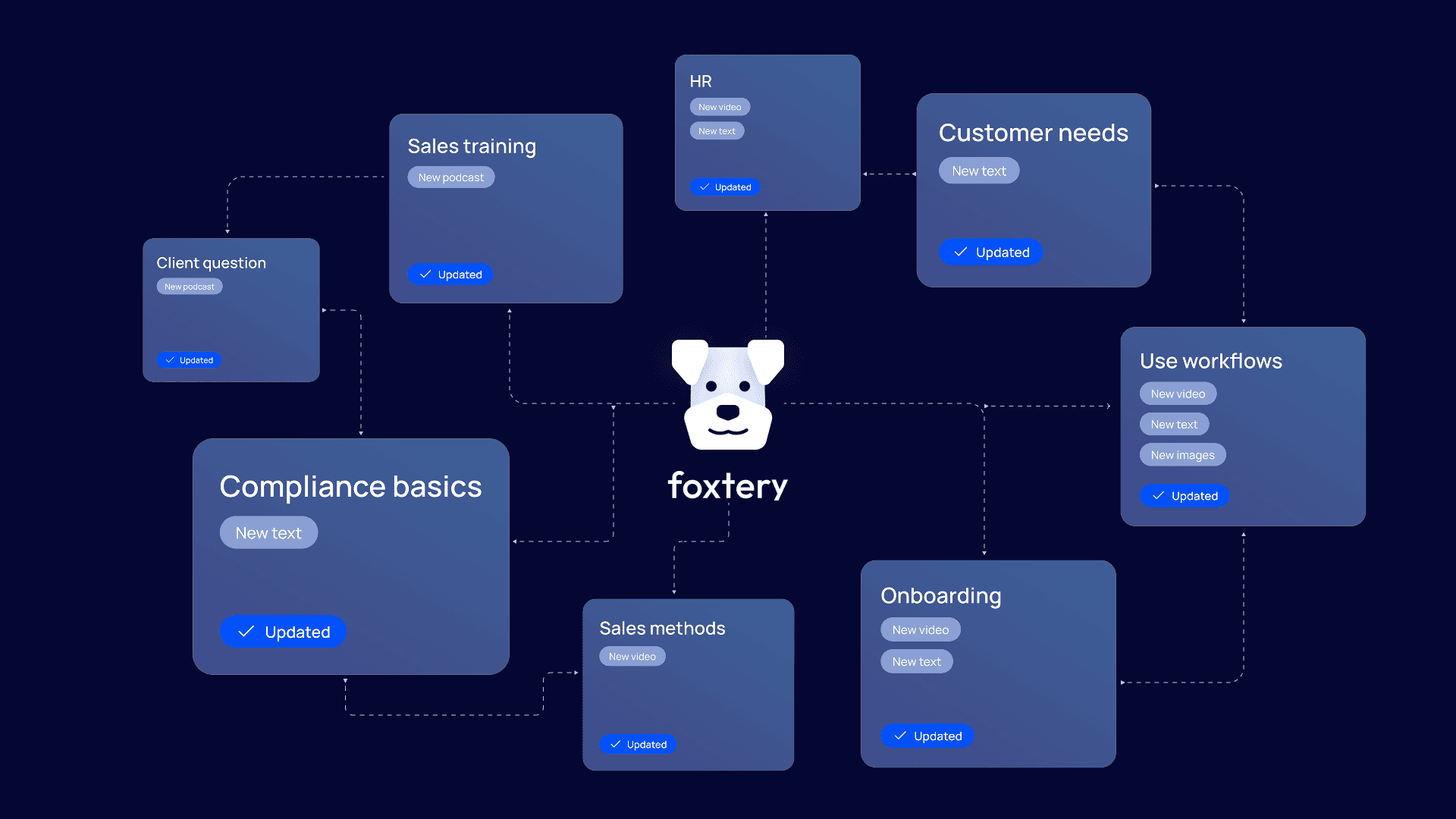
Foxtery platform helps companies turn dry compliance material into interactive & engaging courses that employees genuinely want to take. Instead of another click-through slide deck, learners get experiences built from 40+ formats such as:
scenario-based exercises,
role-play simulations,
branching dialogues,
video lessons,
knowledge checks,
case studies, and more!
The part that surprises most L&D teams: a comprehensive, fully structured compliance course takes about 30 minutes to build. Upload your existing documentation, policies, or recordings - Foxtery handles the rest. No instructional designers, no video producers, no weeks of back-and-forth reviews.
Technology gap that holds your compliance program back
87% of L&D leaders feel under-equipped with current learning technologies. This infrastructure problem directly causes engagement failures most organizations experience.
Legacy systems can't deliver interactive experiences modern learners expect. These platforms lack critical features: adaptive pathways, multimedia integration, real-time analytics, mobile accessibility.
The consequences extend beyond engagement. When 75% of training managers report dissatisfaction with their eLearning strategy, the problem is that available tools don't match organizational needs.
Organizations addressing this gap through blended approaches see better outcomes: 54% using both internal and partner-developed content report higher engagement and more consistent regulatory compliance.
Core compliance training categories your program must cover
Traditional compliance training encompasses workplace safety regulations (OSHA standards), data privacy requirements (HIPAA for healthcare, GDPR for EU operations), anti-harassment and discrimination policies, and financial compliance (SOX for public companies, anti-money laundering protocols).
60% of risk and compliance professionals plan cybersecurity training over the next 2-3 years. It reflects increased regulatory scrutiny of data protection practices.
Urgency is greater for AI governance:
73% of executives expect their companies will have critical AI skills gaps within 12 months.
59% of workers will require significant new training by 2030 to meet new job requirements.
L&D professionals must plan for continuous curriculum development rather than treating compliance topics as static requirements.

Remote work introduces additional considerations around data security, cross-border employment regulations, and distributed team management that weren't priorities 3 years ago.
What makes compliance training actually work
Effective compliance training shares specific characteristics that separate it from checkbox exercises.
Human support matters. Purely automated programs miss contextual explanations that drive comprehension.
Gamification elements impact motivation. 83% of employees feel more motivated when training includes game mechanics, translating to higher completion rates and better retention (Note: gamification alone doesn't guarantee effectiveness)
Business outcomes validate investment in quality programs. Employees who complete formal training are 21% more productive and 17% more profitable. It means that effective compliance training improves performance beyond basic risk mitigation.
Program maturation trends support this: 57% of compliance programs now operate at 'managing' or 'optimizing' stages, up 7% from the previous year.
How to measure compliance training ROI beyond completion rates
The fundamental ROI metric remains clear: $1 invested in compliance training prevents $3 in legal or security-related damages. This is 3:1 return that establishes the baseline business case. Risk mitigation value scales with program quality: the $14.8 million average fine for poorly managed programs represents the downside of ineffective training.
Business outcome metrics demonstrate even broader value: 21% productivity gain and 17% profitability improvement from formal training programs quantify operational benefits beyond compliance.
Behavior change measurement matters more than completion rates. Tracking on-the-job application, incident reduction, audit findings, and policy violation trends reveals whether training actually changes decisions. 78% of business leaders now see the skills gap as a major organizational risk. It creates opportunity for L&D to position compliance training as strategic capability development that addresses executive concerns.
Why half your employees skip compliance training (and what it's costing you)
Engagement crisis in compliance training has nothing to do with employee motivation. Research shows 49% of workers skip through mandated training purely for completion purposes, while 90% who complete it learn nothing useful.
Mid-sized companies with poorly managed compliance programs face average fines of $14.8 million. These penalties result from compliance failures that ineffective training creates. Organizations that implement strategic compliance training see a 3:1 return, with every dollar invested preventing $3 in legal or security-related damages.
Training managers (75% of them) report dissatisfaction with their organization's eLearning strategy. Outdated platforms can't deliver engagement features that drive retention. The problem is that current delivery methods fail to create learning experiences worth engaging with.
Conclusion
Compliance training effectiveness depends on infrastructure and content.
87% of L&D leaders feeling under-equipped with current technologies and the 49% of employees skipping through training represent the same systemic problem: legacy platforms can't deliver the experiences required for behavior change. Organizations addressing this through modern delivery methods and blended sourcing approaches demonstrate that transformation is achievable.
The maturation trend (57% of programs now at managing or optimizing stages) shows the field advancing toward strategic & outcomes-focused approaches.
L&D professionals who position compliance training as capability development rather than regulatory burden gain executive support and budget allocation to build programs that actually work.
