
Art Maslow
Founder of Foxtery


Most L&D teams treat training as a compliance checkbox, not a retention strategy. The result: agents leave within months: they also take institutional knowledge and customer relationships with them.
Metrigy research shows turnover jumped from 21.8% in 2022 to a projected 31.2% in 2024. It costs organizations $15,000–$25,000 per lost agent.
Why 42% of your service team will quit this year (and how training stops it)
Nearly half of employees will leave within a year if development needs aren't met. The cost-benefit calculation is stark: upskilling an existing agent costs 50% less than hiring a replacement. Yet most organizations continue treating training as discretionary spend.
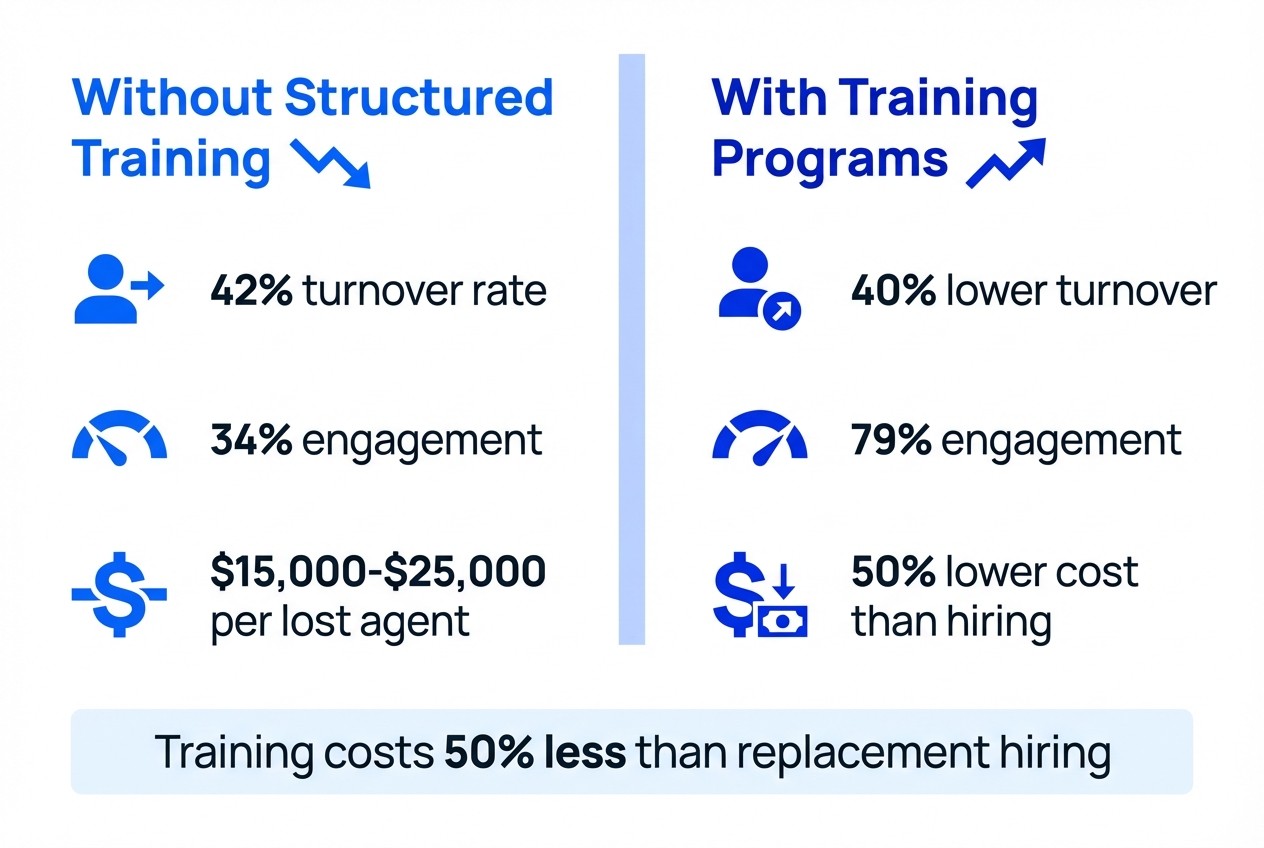
Companies with decent training programs see 79% employee engagement versus an industry average of 34%. The pattern is consistent: organizations that invest early in capability development retain talent longer and spend less on recruitment.
The $370 billion question: what ROI should you expect from service training?
Global service sector training spend reached $370 billion in 2023. It means that organizations are betting big on capability development. And the question is whether the investment delivers measurable returns.
Companies with high-quality customer service training see 24% higher profit margins than peers without structured programs. Soft skills training alone delivers $1,400 per employee in saved time through faster resolutions and fewer escalations. Agent upskilling reduces cost-per-contact by 15% through faster issue resolution.
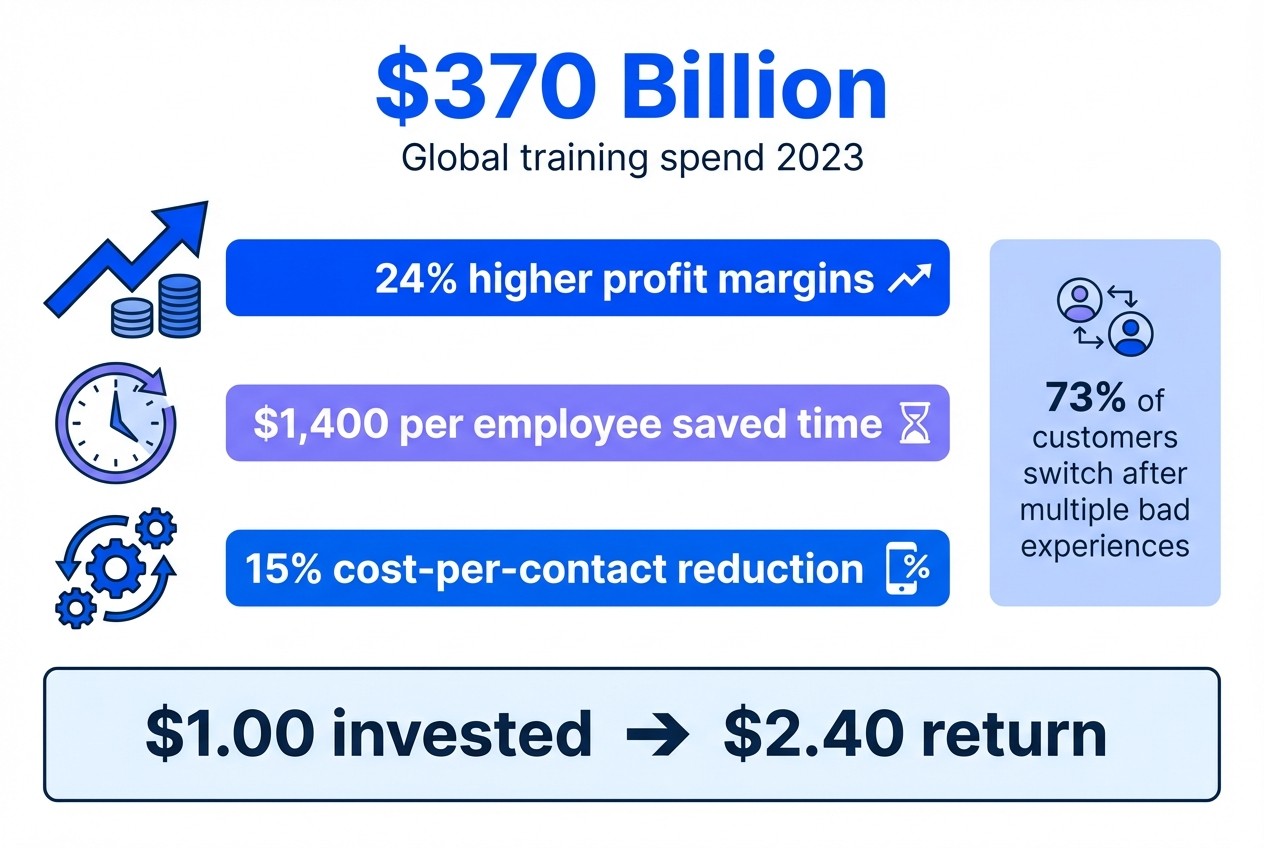
Every dollar invested in customer service training returns $2.40 in profit margin gains and operational savings. L&D teams that quantify these outcomes secure executive buy-in faster. 73% of customers switch after multiple bad experiences.
Core competencies your training curriculum must cover
Active listening and empathy form the foundation: 86% of customers now expect these skills across all channels. Omnichannel fluency follows: the ability to maintain conversation context and tone as customers move between phone, chat, email, and social channels.
63% of agents struggle to deliver both fast and high-quality service. Training must address this tension explicitly. It should aim to provide frameworks for managing performance trade-offs under pressure. Speed without quality creates repeat contacts. Quality without speed frustrates customers and increases handle time.
AI collaboration skills represent the emerging competency. 72% of service leaders view AI as agent support.
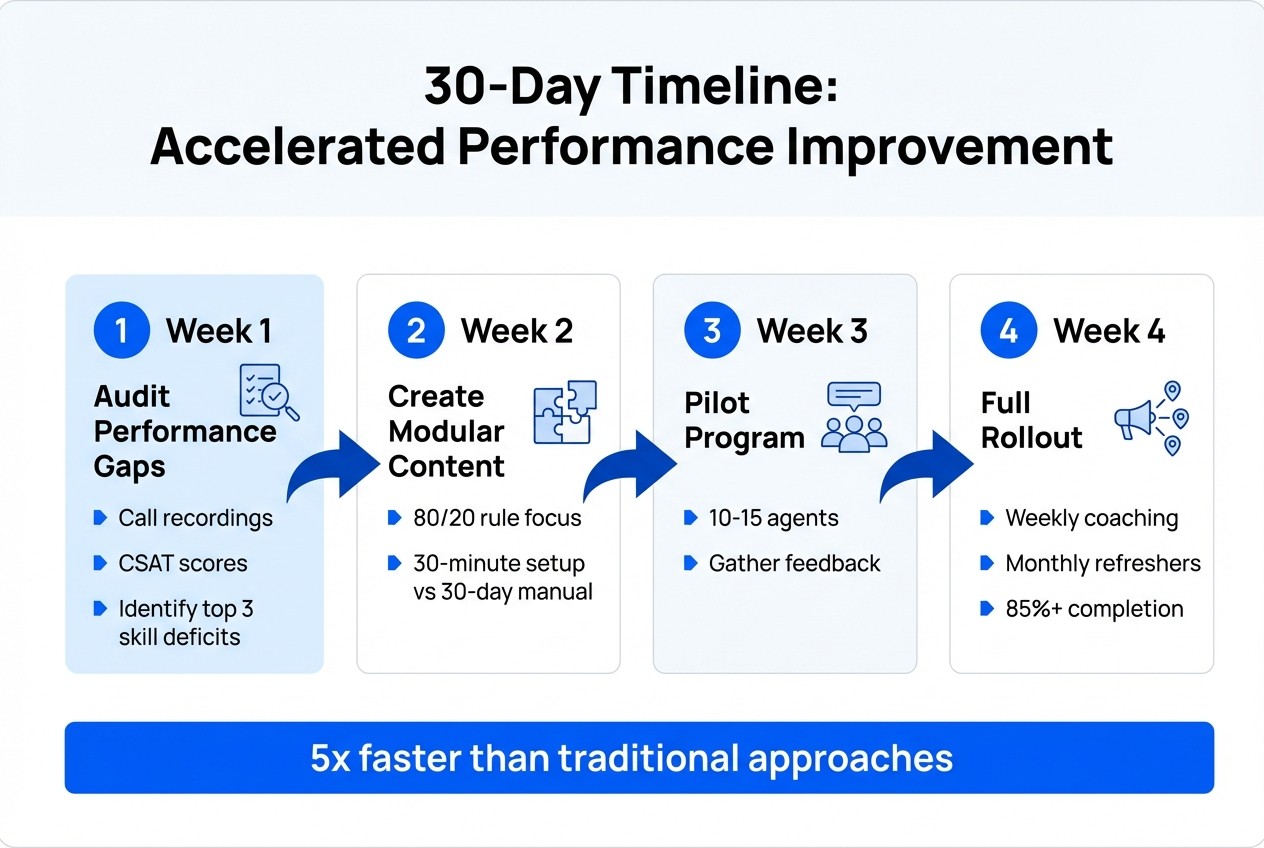
How to build a customer service training program in 30 days
Week 1:
Audit current performance gaps using call recordings, CSAT scores, and agent self-assessments.
Identify 3 highest-impact skill deficits. These are affecting 70% or more of customer interactions.
Outcome: a prioritized list that drives curriculum design.
Week 2:
Source or create modular content. Prioritize the 80/20 rule: focus on skills that drive 80% of outcomes.
Modern L&D platforms enable 30-minute program setup versus traditional 30-day manual builds. Platforms like Foxtery allow L&D teams to build and deploy training programs in 30 minutes versus 30 days.
Week 3:
Pilot with 10–15 agents, gather feedback, iterate on delivery format.
Week 4:
Full rollout with built-in reinforcement cadence: weekly coaching check-ins, monthly skill refreshers. Organizations that follow this framework see training go live five times faster than traditional approaches, with completion rates above 85%.
Training delivery methods that actually stick
Microlearning modules deliver 80% knowledge retention versus 20% for hour-long lectures. Role-play simulations show 3x higher skill application rates versus passive video watching.
Example, how text role-play simulation done via Foxtery platform:
Peer coaching circles leverage the fact that 65% of agents prefer learning from colleagues over formal trainers. This approach builds community and reduces isolation. Self-paced eLearning offers flexibility but requires strong intrinsic motivation (completion rates drop to 30% without accountability structures.)
Avoid one-and-done workshops with no reinforcement. 90% of learning is lost within 30 days without follow-up.
Blended approaches (microlearning plus role-play + peer coaching) deliver 70% higher skill transfer than single-modality programs. L&D teams should mix formats based on skill complexity and agent learning preferences.
Measuring what matters: KPIs that prove training impact
Leading indicators predict future performance:
training completion rate,
knowledge check scores,
time-to-competency for new hires.
Lagging indicators reveal actual outcomes:
CSAT/NPS changes,
first-contact resolution rate,
average handle time,
escalation rate,
agent retention at 6 and 12 months.
Financial metrics translate training outcomes into executive-friendly dollar impact:
cost-per-contact reduction,
revenue per agent,
customer lifetime value impact.
Only 21% of employees feel they have adequate performance feedback.
Set baseline metrics pre-training, then track monthly for 90 days to isolate training impact from seasonal or market factors. L&D teams that track all 3 metric types - leading, lagging, financial -secure 3x more budget approval than those reporting completion rates alone.
Common training mistakes that tank ROI
Training without performance baselines makes impact impossible to prove. Establish starting metrics before launch. One-size-fits-all curricula ignore the reality that new hires need foundational skills while veterans need advanced techniques and career pathing.
No reinforcement cadence guarantees failure. Schedule monthly refreshers. Ignoring agent input misses critical pain points: 63% struggle with speed-quality tradeoffs, yet most training ignores this tension.
Treating training as an event rather than a process undermines long-term capability building. Top-performing organizations embed learning into daily workflows through micro-moments and coaching check-ins. The shift from episodic training to continuous development separates retention leaders from organizations trapped in perpetual hiring cycles.
Conclusion
Customer service training exposes whether organizations view frontline agents as cost centers or competitive assets. Data settle the question: structured development programs deliver 24% profit margin gains, $1,400 per-agent savings, and 40% turnover reduction.
The shift from 6-month curriculum builds to 30-day rapid deployment removes the primary barrier L&D teams face: time. Platforms like Foxtery compress what used to require weeks of manual content assembly into hours of strategic design work.

