
Art Maslow
Founder of Foxtery


Here's something that would have seemed impossible two years ago: 73% of talent acquisition leaders now rank critical thinking as their #1 recruiting priority for 2026, when AI technical skills rank only 5th. The rules have completely reversed.
Technology is advancing faster than human readiness. Your teams have powerful AI tools but struggle with judgment calls those tools can't make. The bottleneck here is human capability.
Organizations that build strategic soft skills training now will develop the human advantage competitors can't replicate. You'll learn which capabilities matter most in 2026's AI-driven workplace and how to deploy training that changes behavior.
Why soft skills training has become your competitive differentiator
Technical skills have become commoditized. Anyone can learn to prompt an AI or run a data query. The differentiator is what happens next.
Can your employees evaluate whether the AI's recommendation makes sense? Do they know how to persuade stakeholders when data conflicts with institutional knowledge? Can they adapt when their role changes for the third time this year?
Only 28% of organizations are positioned to turn AI deployment into high-value outcomes due to a lack of 'human readiness' and gaps in talent foundations. Companies invest millions in AI infrastructure while their people lack the judgment skills to use it effectively.
Required skills are changing 66% faster in AI-exposed occupations than in jobs with minimal AI interaction. This acceleration means static technical training becomes obsolete before employees can apply it. Human skills such as critical thinking, adaptability, interpersonal influence provide the durable foundation that allows your workforce to navigate continuous change.
Soft skills are no longer supplementary training offered after technical onboarding. They're the primary capability set that determines whether your organization can execute on AI investments.
How to build a strategy for soft skills development in 2026
Instead of overwhelming teams with 20 disconnected skills, organize soft skills training into four interconnected capability areas.
Adaptive thinking: critical analysis and AI collaboration
Your employees need to work alongside AI agents, not just use them as tools. That requires a fundamentally different skill set.
Only 6% of leaders say they are making progress in designing human-AI interactions, despite 85% acknowledging it is critical to build the workforce's ability to adapt at speed. This gap exists because most organizations focus on teaching how to use AI rather than when to trust its output and when to override it.
Adaptive thinking training should focus on:
Evaluating AI recommendations. Teach employees to identify when AI outputs are plausible but incorrect, biased, or missing critical context
Decision-making with imperfect information. Build frameworks for making judgment calls when data conflicts or is incomplete
Scenario-based learning. Use realistic simulations where employees practice choosing between AI suggestions and their own expertise
Asking better questions. Train teams to probe AI outputs rather than accepting them at face value
The most effective approach combines theoretical frameworks with hands-on practice. Instead of just explaining critical thinking, create situations where employees must demonstrate it under realistic constraints.
Text Roleplay: practice real conversations before they happen
Most training tells employees what to do. Foxtery's Text Roleplay makes them actually do it.
It's an interactive format inside Foxtery where your employee has a live text conversation with an AI assistant that has the full context of your course. No, it's not a quiz or a video to watch, but a back-and-forth dialogue where they apply knowledge, make decisions, and get challenged in real time.
AI assistant explains the reasoning, asks follow-up questions, and pushes the employee to think deeper.
Let's use soft skill training on Delivering Difficult Feedback as an example:
1. Set the scene
Write a realistic scenario and drop it into the course as context.
You are a team lead. Your direct report Marcus has missed six deadlines in six weeks. You have a 1:1 today. He opens with: "I feel like I'm finally getting back on track." How do you respond?
2. Add the Text Roleplay block with your question
Let us use this example:
'Marcus says he's getting back on track. What's your move?
A) "Great to hear, let's keep that going!" — avoidance
B) "I'm glad you brought that up — I want to talk about the last few weeks." — direct
C) "I appreciate that, though I do want to share some observations." — diplomatic
D) "Can you walk me through what 'back on track' means to you?" — turns it into dialogue'
From here, the AI takes over. It responds to whatever the employee picks, explains the tradeoffs, and continues the conversation with new situations.
3. Share the link
Your employee opens the course, enters the scenario, and starts their learning journey.
Interpersonal influence: communication and collaboration
AI can draft the email, but it can't read the room. It can't sense when a stakeholder is hesitant for reasons they haven't articulated. It can't build the trust that makes difficult conversations productive.
These human-to-human capabilities are becoming more valuable precisely because they're irreplaceable. 78% of talent say they learn soft skills from older colleagues. It emphasizes on one thing: intergenerational collaboration is your most effective L&D channel.
Structured interpersonal training should include:
Pillar | Explanation |
|---|---|
Cross-generational knowledge | pair experienced employees with newer team members; Make this bidirectional: younger employees teach digital fluency, veterans - teach stakeholder management. |
Persuasion and influence training | teach employees how to build coalitions, navigate organizational politics ethically, and gain buy-in when they lack formal authority. |
Conflict resolution for hybrid teams | Your teams need explicit frameworks for addressing tension productively when they're not in the same room. |
Psychological safety building | Train managers and team members to create environments where this feels safe rather than risky. |
Emotional intelligence: self-awareness and resilience
98% of executives are planning organizational design changes over the next two years to address skills shortages, yet employee burnout has left only 44% reporting they are thriving at work.
Your employees are being asked to continuously reinvent their roles while already operating at capacity. Emotional intelligence is to build the resilience and self-awareness that allows people to function effectively during constant change.
The problem: most EQ training is too abstract. Telling someone to "be more self-aware" doesn't give them actionable tools.
Solution: focus on specific, trainable behaviors.
Read relevant article on how to grow leaders with strong & developed emotional intelligence here.
Strategic execution: initiative and accountability
Ideas are cheap. Execution in ambiguous environments is what separates high performers from everyone else.
Pillar | Explanation |
|---|---|
Project management fundamentals for non-PM roles | cover scope definition, stakeholder management, and risk identification. |
Ownership and follow-through training | Teach employees how to break ambiguous projects into concrete next steps, identify dependencies early, and communicate proactively when timelines shift. |
Cross-functional collaboration skills | Employees need to understand how to navigate different team cultures, align on shared objectives when incentives don't perfectly overlap, and resolve conflicts between competing priorities. |
Measuring and communicating impact | Train employees to quantify their contributions in business terms rather than activity metrics. |
Common soft skills training mistakes that undermine results
Most soft skills programs fail because the implementation ignores how adult learning actually works.
The biggest mistake is treating soft skills as optional enrichment rather than strategic imperatives. When budget gets tight, these programs get cut first. This signals to employees that these capabilities don't actually matter, which becomes a self-fulfilling prophecy.
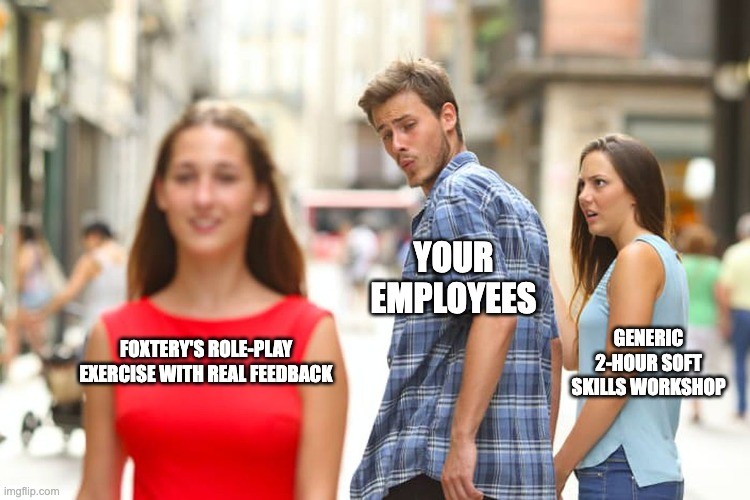
One-size-fits-all training is another common failure mode. The communication skills a sales leader needs are fundamentally different from what a software engineer needs. Generic soft skills workshops that don't connect to role-specific contexts feel theoretical and get forgotten within days.
Perhaps most damaging is delivering content without practice opportunities or feedback loops. You can't build critical thinking by listening to a lecture about critical thinking. Adult learning requires application, failure, feedback, and iteration. Programs that skip this step waste everyone's time.
The connection to business outcomes often gets lost entirely. When L&D can't articulate why adaptability training will improve project delivery timelines or how emotional intelligence development reduces turnover, executives rightfully question the investment.
Finally, neglecting manager involvement guarantees failure. Managers either reinforce or undermine training through their daily interactions with employees. If you train employees on psychological safety but their manager punishes mistakes, the training creates cynicism.
Your 90-day soft skills training implementation plan
Theory without execution is just expensive shelf-ware. Here's how to move from strategy to deployed training in 90 days.
Phase 1 - Assess and prioritize (Days 1-30)
Look at project post-mortems. Where did initiatives stall? Was it due to technical gaps or human factors like poor stakeholder management or inability to adapt when requirements changed?
Interview managers about where their teams struggle. Are people great at individual execution but poor at cross-functional collaboration? Do they have technical expertise but struggle to communicate recommendations to non-technical stakeholders?
Identify 2-3 high-impact roles for your initial rollout. You want roles where soft skills gaps are creating visible business problems and where you have supportive managers who will reinforce the training.
Align your skills priorities with business strategy. If your company is shifting to AI-augmented workflows, adaptive thinking and AI collaboration skills should top your list. If you're scaling rapidly, focus on interpersonal influence and strategic execution.
Build stakeholder buy-in by connecting training to metrics executives already care about. Frame adaptability training as reducing project delays. Position conflict resolution skills as improving cross-functional initiative success rates.
Phase 2 - Design and deploy (Days 31-60)
93% of 'talent velocity leaders' believe human skills are more important than ever, and these organizations are 1.6 times more likely to have high adoption of in-demand human skills compared to laggards.
Choose delivery formats based on the skill you're teaching and your organizational culture.
Workshops work well for interpersonal skills that require live interaction and feedback.
Microlearning modules suit conceptual frameworks employees can apply asynchronously.
Peer coaching excels at knowledge transfer and relationship building.
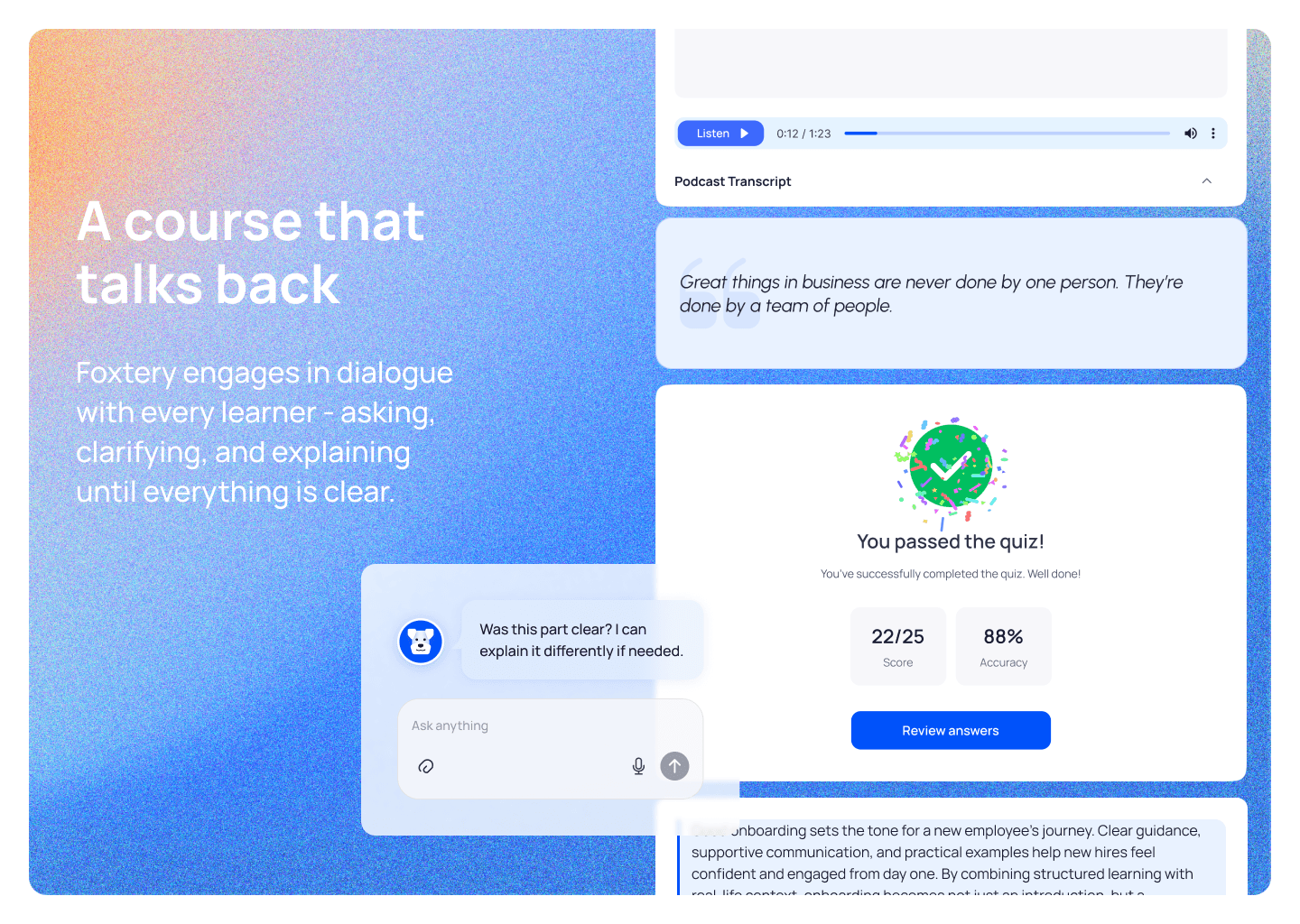
Create practice scenarios and simulations that mirror real work situations. With Foxtery, you can get it done in just 30 minutes.
If you're training critical thinking for AI collaboration, use actual AI outputs from your tools and have employees evaluate them. If you're building conflict resolution skills, use sanitized versions of real conflicts your teams have faced.
Launch pilot programs with your identified high-impact roles before rolling out company-wide. This lets you iterate based on feedback and build internal case studies that make broader adoption easier.
Here's where speed becomes your competitive advantage: traditional training development takes weeks or months. Foxtery helps L&D teams launch comprehensive soft skills training programs in 30 minutes, not weeks.
Phase 3 - Reinforce and measure (Days 61-90)
Training without reinforcement is just expensive entertainment. The real work begins after the initial program launch.
Manager coaching is non-negotiable. Train managers to recognize and reinforce the behaviors you taught. Give them specific language for providing feedback.
Measure behavior change, not completion rates. Who cares if 95% of employees completed the adaptability module if their actual behavior hasn't changed? Track leading indicators like how quickly teams pivot when priorities shift, or how often employees proactively flag risks in ambiguous projects.
Build feedback loops into your program design. Survey participants 30 days after training to understand what they've applied and where they're still struggling. Use this data to iterate on content and identify where additional support is needed.
Scale successful programs strategically. Don't try to train everyone on everything simultaneously. Focus on building depth in your pilot groups first, then expand to adjacent roles where you've validated the approach.
How to measure soft skills training impact
If you're reporting training success based on completion rates and satisfaction scores, you're measuring the wrong things.
Behavioral indicators tell you whether training actually changed how people work.
For adaptive thinking training, track how often employees question AI outputs versus accepting them uncritically.
For interpersonal influence, measure how frequently people seek input from stakeholders before finalizing decisions.
Performance metrics should reflect soft skills application in real work contexts:
Project success rates: Do cross-functional initiatives complete on time more often after collaboration training?
Time-to-productivity for new hires: Does emotional intelligence training reduce the onboarding period?
Innovation metrics: Are teams generating and testing more ideas after psychological safety training?
Retention rates: Do employees who complete adaptability training stay longer during organizational changes?
Customer satisfaction scores: Does communication training improve client relationships?
Qualitative feedback mechanisms provide context numbers can't capture. Conduct structured interviews with managers about how their teams' capabilities have evolved. Create peer feedback processes where colleagues can recognize specific instances of soft skills application.
ROI calculation for soft skills requires connecting behavior change to business outcomes. If conflict resolution training reduces project delays by an average of two weeks, calculate the cost of those delays and compare it to your training investment. If critical thinking development helps teams avoid costly mistakes from uncritically implementing AI recommendations, quantify the value of risk mitigation.
Conclusion
Soft skills have moved from supplementary training to strategic imperative. Organizations that understand this change are building the human advantage their competitors can't replicate through technology alone.
Our framework provides structure for comprehensive development:
Adaptive Thinking builds the judgment skills needed to work effectively alongside AI.
Interpersonal Influence develops the human-to-human capabilities that remain irreplaceable.
Emotional Intelligence creates the resilience and self-awareness required to navigate constant change.
Strategic Execution enables employees to translate ideas into action in ambiguous environments.
Speed of implementation matters. Organizations that move faster on soft skills development see 1.6 times higher adoption rates than those that delay. Your competitors are building these capabilities right now - the question is whether you'll lead or follow.
Ready to accelerate your soft skills training deployment?
Foxtery helps L&D teams launch comprehensive training programs in 30 minutes. From critical thinking scenarios to collaboration exercises, you can deploy adaptive training at the speed your business demands. See how fast you can build your human advantage.

