
Art Maslow
Founder of Foxtery


Here's the paradox: despite record investment in sales technology, average ramp time for SaaS Account Executives has climbed to 5.7 months. Nearly half a year before your new hire operates at full capacity.
The problem, however, isn't lack of effort. We measure the wrong thing.
Traditional onboarding focuses on time-based milestones: complete product training by week two, shadow five calls by week three. But these activity checkpoints don't answer the critical question:
Is this rep actually competent?
In 2026, leading sales organizations are shifting from time-based metrics to competency-based frameworks. They're asking not "How long has this rep been here?" but "What can this rep actually do?"
In this article we'll talk about a four-pillar approach to accelerate true competency. These combine knowledge mastery, skills development, AI integration, and coaching cadence. You'll learn specific milestones for 90-day implementation, measurement frameworks beyond vanity metrics, and how to avoid pitfalls that extend ramp time.
Understanding time to competency vs. time to productivity
Time to productivity measures when a rep starts generating output.
Time to competency measures when they consistently execute at a high level.
A rep might close their first deal in month three (productivity) but still struggle with discovery calls, misposition your product, and require hand-holding on every opportunity (lack of competency). They're productive in the narrowest sense, but not operating independently.
Traditional "time-in-seat" measurements fail because they conflate presence with capability. A rep at 90 days isn't automatically more competent than one at 60 days. What matters is what they've mastered.
This has real business consequences. According to research on sales ramp time, the average SaaS AE takes 5.7 months to reach full productivity. But that masks huge variation: some reps plateau at 60% of quota while others surge past 120%. The difference is competency.
When you measure competency instead of time, you identify exactly where reps are stuck. Maybe they've mastered product knowledge but struggle with objection handling. These specific gaps are actionable. "Needs more time" is not.
The business case for accelerating sales competency
Extended ramp periods are expensive in ways that don't show up on P&L statements. Start with vacant territory costs.
If your average AE carries a $1M quota and takes six months to ramp, that's $500K in unrealized revenue per hire. Multiply that across a team of 20 reps with 30% annual turnover, and you're looking at $3M in opportunity cost.
Then there's the hidden drag. Managers spend hours coaching struggling reps instead of driving deals. Top performers get pulled into training sessions. The entire sales motion slows down.
Now consider the upside. Organizations with formal onboarding programs boost retention by 82% and productivity by over 70%. That's transformational.
The ROI is equally compelling. Research shows that for every dollar invested in sales training, companies receive about $4.53 in return – a 353% ROI. But 62% of organizations admit their onboarding programs fall short.
Before structured onboarding | After structured onboarding | |
|---|---|---|
Quota attainment | 47% | 76% |
Time to first deal | 6+ months | 3 months |
Manager hours/weeks | 12h | 4h |
Retention at 12 months | 52% | 82%+ |
Revenue per hire | $0 for 6 months | Revenue from month 3 |
The gap between potential and reality represents your opportunity. Organizations that crack the competency code fill territories faster and build sustainable competitive advantage.
Four-pillar competency framework
Most onboarding programs are collections of activities without a unifying structure. Reps complete modules and shadow calls, but nobody can articulate what "done" looks like.
The four-pillar framework provides that structure. These pillars are:
Knowledge foundation,
Skills development,
AI integration,
Coaching cadence.
They represent the essential dimensions of sales competency. They're interdependent. A rep with deep product knowledge but poor discovery skills won't hit quota. Neither will someone with great skills but no AI fluency in 2026.
Let's break down each pillar.
Pillar 1: Structured knowledge foundation
Knowledge is the prerequisite for everything else. You can't practice what you don't understand.
But not all knowledge is equal. Many programs dump everything on new hires at once: product features, competitive intel, buyer personas, pricing, internal systems. The result? Overwhelm and retention of almost nothing.
Structured knowledge architecture sequences information deliberately:
Week 1-2: Core product value propositions and primary use cases. What problems do we solve? For whom?
Week 3-4: Competitive positioning and battle cards. Who do we compete against? Where do we win?
Week 5-6: Deep dives into buyer personas and ICP characteristics. What titles do we sell to? How do they evaluate vendors?
This sequencing prevents cognitive overload while building a foundation for skills practice.
The business impact is significant. Companies with a standardized sales process experience up to a 28% increase in revenue compared to those without. That standardization starts with ensuring every rep masters the same core knowledge.
Pillar 2: Skills development through practice
Knowledge tells you what to do. Skills make you actually do it.
This is where most programs fail. They provide information but not practice. Reps learn about discovery methodology in a classroom, then get thrown into live calls. It's like teaching someone to swim by explaining water physics, then pushing them into the deep end.
Read our article about corporate learning predictions for 2026 to learn more about practical shifts around performance, AI-powered workflows, and what teams should prioritize next.
Effective skills development requires structured practice in safe environments:
Role-playing exercises where reps practice discovery calls with colleagues playing difficult prospects
Recorded mock demos that managers review and provide specific feedback on
Objection handling drills using real objections from recent lost deals
Pipeline review simulations where reps defend their forecast to mock leadership
The key is progressive complexity. Start with scripted scenarios, then introduce variables, then move to unscripted situations that mirror real-world chaos.
Repetition matters more than most enablement teams realize. A rep who role-plays discovery once will fumble in real calls. A rep who practices 20 times develops muscle memory. They stop thinking about the framework and start listening to the prospect.
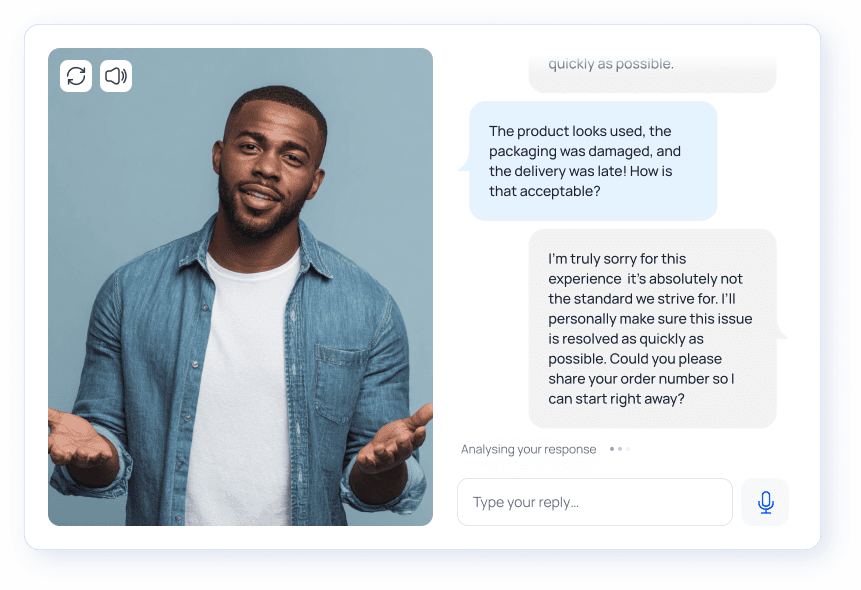
Foxtery's role-play simulator gives every rep their own practice environment, available on demand. You don't need to pull a manager or a colleague into the room anymore.
Foxtery generates realistic prospect personas based on your actual ICP. The rep enters a simulated sales conversation and works through it in real time. The AI prospect pushes back, raises objections, goes cold, asks hard questions, etc. It behaves the way real prospects behave.
After each session, the rep receives structured feedback: where they lost momentum, which objections they handled well, where they talked too much, where they missed an opportunity to ask a follow-up question.
Pillar 3: AI-assisted acceleration
AI isn't replacing salespeople in 2026. But salespeople who use AI effectively are replacing those who don't.
Sellers who effectively partner with AI tools are 3.7 times more likely to meet quota than those who don't. That's a fundamental shift in how top performers operate.
The competency question is: What does "AI partnership" actually mean for new hires?
It means:
training reps to use AI for pre-call research, pulling relevant insights about accounts before every conversation.
using AI note-takers to capture calls accurately so reps can focus on the conversation.
leveraging AI to draft personalized follow-up emails based on call transcripts.
Sales teams using AI tools are seeing a 14% increase in productivity, primarily by reducing administrative burden. When reps spend less time on data entry, they spend more time actually selling.
But here's the critical caveat: ungoverned AI use creates massive risk. Forrester predicts that ungoverned use of generative AI will cost B2B companies more than $10 billion in enterprise value through declining stock prices and fines. Reps need to understand not just what AI can do, but what it shouldn't do (like sharing confidential customer data with public models).
Pillar 4: Manager-led coaching cadence
Technology and training programs can't replace human coaching. They can only improve it.
The data on coaching frequency is stark: In teams where reps are coached weekly or more, 76% are hitting quota, compared to only 47% for those coached quarterly or less. That 29-point gap represents the difference between high-performing and struggling teams.
Effective coaching during onboarding follows a specific structure:
Weekly 1:1 sessions (30-45 minutes) focused on one competency area at a time. Week one might focus on discovery questions. Week two on handling a specific objection.
Real-deal debriefs where managers and reps analyze actual calls – what worked, what didn't, what to try differently. This isn't about criticism. It's about pattern recognition.
Progressive deal complexity where managers deliberately assign smaller deals first, then gradually increase difficulty as competency grows.
Joint calls and ride-alongs where reps observe managers, then managers observe reps, providing immediate feedback while the experience is fresh.
The challenge is that most sales managers weren't trained as coaches but they were promoted for being great sellers. Organizations that invest in developing manager coaching skills see exponential returns.
Sellers are 63% more likely to be top performers when supported by an effective manager offering regular coaching. That effectiveness requires structure, cadence, and commitment.
How to measure competency: beyond activity metrics
You can't improve what you don't measure. But most sales organizations measure the wrong things.
Activity metrics like calls made, emails sent, meetings booked tell you what reps are doing. They don't tell you whether reps are competent.
Competency measurement requires different frameworks:
Certification checkpoints at 30, 60, and 90 days where reps must demonstrate specific capabilities.
> At 30 days, can they articulate your value proposition and run a discovery call?
> At 60 days, can they handle the top five objections?
> At 90 days, can they navigate a complex deal cycle independently?
Skills assessments using recorded calls scored against rubrics. How effectively did the rep build rapport? Did they ask open-ended questions? Did they connect product features to customer pain points?

Knowledge checks throughout onboarding, not just at the end. Spaced repetition testing ensures retention. A rep who scores 90% on a product quiz in week two but can't remember key details in week eight hasn't achieved competency.
Leading indicators that predict future performance: quality of questions in discovery calls, depth of account research before meetings, effectiveness of email communication. These behaviors correlate with eventual quota attainment better than activity volume.
The payoff for getting measurement right is substantial. Organizations that utilize post-training reinforcement see 34% more first-year sales reps achieve quota. Reinforcement requires measurement. You can't reinforce what you haven't assessed.
Create scorecards that combine quantitative and qualitative measures. Track both what reps accomplish and how they accomplish it.
Common pitfalls that extend ramp time
Even well-intentioned enablement teams make predictable mistakes:
1. Information overload in week one. Dumping 40 hours of training content on new hires in their first week guarantees they'll retain almost nothing. Spread foundational knowledge across weeks, not days.
2. One-size-fits-all onboarding paths. An SDR needs different competencies than an AE. An AE selling to an enterprise needs different skills than one selling to SMB. Generic programs produce generic results.
3. Missing feedback loops. Reps complete modules and shadow calls but receive no structured feedback on their performance. Without feedback, there's no learning.
4. Treating onboarding as an event. Most programs have a defined end date "You're done after 90 days." But competency development is continuous. Organizations that frame onboarding as the beginning of a learning journey see better long-term results.
5. Insufficient manager involvement. When managers are too busy to coach, new reps flounder. Onboarding can't be delegated entirely to enablement teams. Managers must own their reps' development.
Recognize these patterns in your own program? The gap between knowing what to do and actually doing it is where most organizations get stuck.
Your 90-day competency roadmap
Theory is worthless without implementation. Here's what a competency-based roadmap actually looks like:
Days 1-30: Foundation and observation
Expected productivity: 25%
New hires spend this month building knowledge and observing. They complete core training modules, shadow experienced reps, and begin practicing skills in safe environments. They're not carrying quota yet.
Certification gate: Can articulate value proposition, identify ideal customer profile, and run a basic discovery call in role-play.
Research shows new sales hires typically operate at approximately 25% productivity during their first month, which aligns with this observation-heavy phase.
Days 31-60: Guided practice and first deals
Expected productivity: 50%
Reps begin taking smaller deals with manager support. They run discovery calls independently but with managers listening. They deliver demos with backup. Every interaction is a learning opportunity.
Certification gate: Successfully close first deals, demonstrate objection handling competency, and execute demos without significant manager intervention.
Productivity increases to roughly 50% in month two as reps move from observation to guided execution.
Days 61-90: Independent execution with support
Expected productivity: 75%+
Reps carry full quota and manage deals independently. Managers change from directive coaching ("Do this") to facilitative coaching ("What do you think you should do?"). Weekly coaching sessions focus on refinement, not fundamentals.
Certification gate: Manage complex deal cycles independently, accurately forecast pipeline, and demonstrate consistent execution across all core competencies.
By day 90, competent reps should be operating at 75% or higher of full productivity, with a clear path to 100% by month five.
This roadmap isn't arbitrary. It's based on how adults actually learn – starting with knowledge, progressing to guided practice, then advancing to independent application.
Technology stack for competency acceleration
The right technology accelerates the process. For competency-based onboarding, you need tools in several categories:
Training content delivery platforms that enable rapid deployment of learning modules. The traditional approach f.e. spending weeks building custom content creates bottlenecks. Modern platforms like Foxtery make sure sales enablement teams don't need additional L&D efforts. Share your existing materials (PDFs, videos, voice notes, images) with Foxtery, describe your target audience and learning goals, and deploy a comprehensive training program in 30 minutes instead of 30 days. When content needs updating, upload the revised document and the course reflects the change automatically.

AI-powered coaching tools including conversation intelligence platforms that analyze calls and provide feedback on talk time, question quality, and sentiment. These tools scale coaching beyond what managers can accomplish manually.
Assessment and certification tools that track competency development across multiple dimensions. Spreadsheets don't cut it when you're measuring knowledge, skills, and behaviors across a team of 50 reps.
Practice environments where reps can role-play, record demos, and receive feedback without the pressure of live prospects.
The key is integration. Disconnected tools create administrative burden. Look for platforms that connect training delivery, practice, assessment, and coaching in a unified workflow.
One caution: avoid technology overload. Reps already struggle with CRM, email, LinkedIn, and a dozen other tools. Choose tools that reduce complexity, not increase it.
From onboarding to continuous competency
The most important insight about sales onboarding is this: it never ends.
Day 90 isn't graduation. It's the beginning of continuous development. Markets change, products evolve, competitors adapt. Remember: top performers treat learning as a permanent state, not a phase.
Organizations that build continuous competency development into their culture see sustained performance advantages. They build learning systems that elevate the entire team.
Start with getting the first 90 days right. Then build the infrastructure for continuous improvement. That's how you create a sales organization that dominates markets.
Conclusion
Well-known saying: work smarter, not harder. Replace time-based milestones with competency-based frameworks, activity metrics with skills assessments, and generic programs with structured development paths.
The four-pillar framework – Knowledge Foundation, Skills Development, AI Integration, and Coaching Cadence – provides the structure. The 90-day roadmap provides the timeline. The measurement frameworks provide accountability.
What's missing is execution. Most organizations know what they should do. Few actually do it.
The competitive advantage in 2026 belongs to organizations that close that gap – that build onboarding programs focused not on how long reps have been here, but on what they can actually do. Start building yours today.

