
Art Maslow
Founder of Foxtery


Most corporate training fails the same test:
Employees complete the module > pass the quiz > can't apply the skill 3 weeks later.
The problem is delivery format. Text-only manuals and slide-heavy presentations ignore how adults actually encode information (through multiple sensory channels working simultaneously).
Multimodal learning is an educational approach that combines visual, auditory, kinesthetic, and textual inputs to deliver information in varied formats that match how learners naturally process information.
Research shows 66% of the population are multimodal learners who need multiple modes to fully encode complex concepts. Single-format training leaves 2/3 of employees underserved.
Moreover, Gartner predicts 80% of enterprise software will be multimodal by 2030, up from less than 10% in 2024. Training platforms that once required six-figure budgets and months of development now enable L&D teams to build video, interactive assessments, and mobile-ready content in hours.
What multimodal learning means
Multimodal learning is an educational approach that engages multiple sensory channels - visual, auditory, kinesthetic, and textual - simultaneously. This differs from the discredited 'learning styles' myth, which suggested people learn best through one preferred mode. Research reveals 66% of learners are multimodal and it requires varied inputs.
VARK model categorizes these modalities:
Visual (infographics, diagrams, videos),
Auditory (podcasts, discussions, verbal explanations),
Read/Write (documentation, articles, written assessments),
Kinesthetic (simulations, role-plays, hands-on practice).
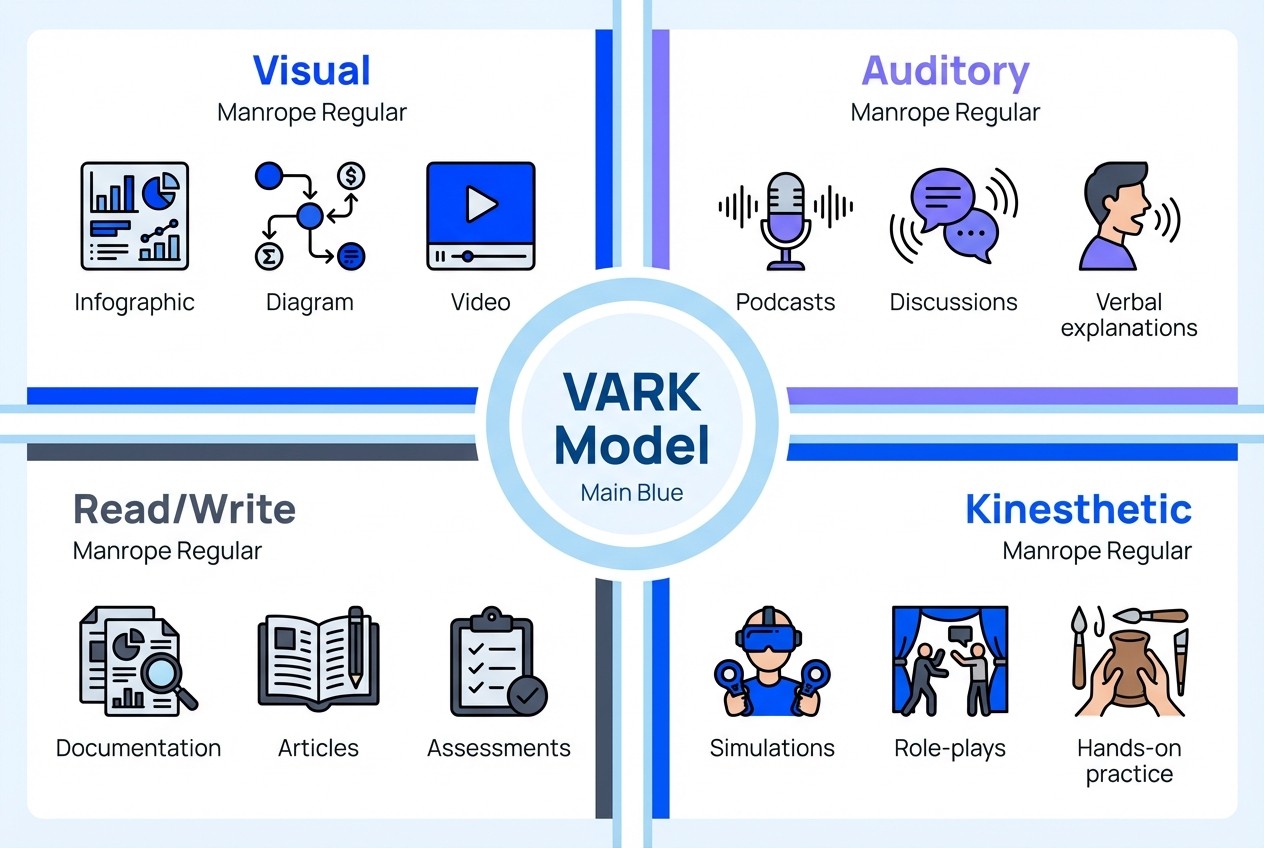
Sales enablement example demonstrates the principle: a product launch training that includes a video demo (visual + auditory), interactive objection-handling scenarios (kinesthetic), and a downloadable battle card (read/write) engages all 4 modalities.
Retention data L&D leaders need to see
Visual learners retain 80% of information seen within 24 hours, compared to only 20% retained from text alone. That 60-percentage-point gap represents the difference between an employee remembering a safety protocol and creating a workplace incident.
Kinesthetic modalities produce similar gains. A study of 8-year-olds learning language found 73% better recall when using gestures and movement versus passive listening. The principle applies to adult learners: role-playing a difficult customer conversation creates stronger memory traces than reading a script.
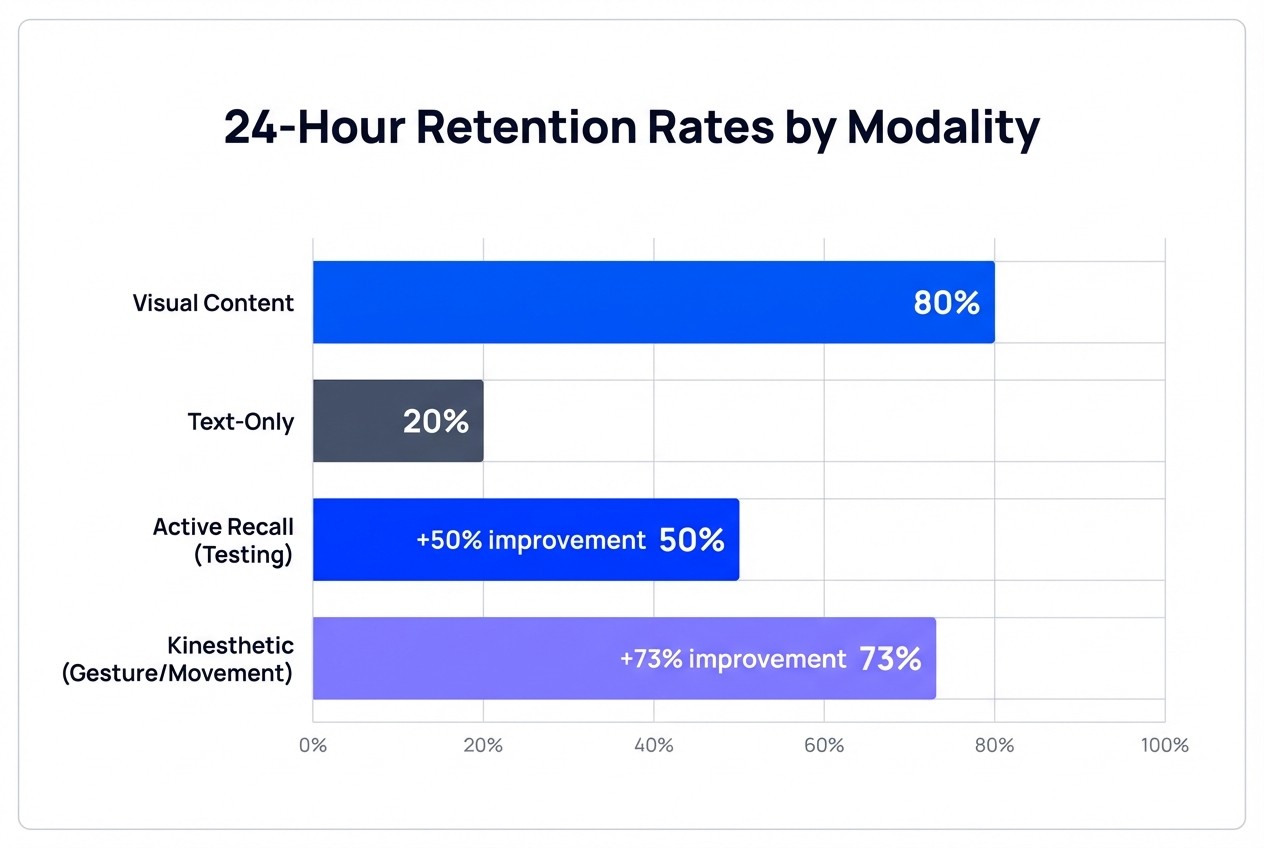
Active recall through interactive testing improves retention 50% compared to passive review. This means quizzes and branching scenarios are key instruments in your learning process.
For L&D teams, these statistics translate directly to business outcomes: higher retention means faster onboarding, fewer errors, better skill transfer to real situations, and lower repeat training costs.
How VR training cuts time by 75% & boosts confidence by 40%
PwC's landmark study found VR learners completed training 4 times faster than classroom participants. That's a 75% time reduction. VR learners were also 3.75 times more emotionally connected to content and four times more focused than e-learners.
VR participants showed 40% improvement in confidence to apply learned skills compared to classroom training, with 35% improvement over standard e-learning. Separately, 95% of VR participants reported better preparation for real-world situations.
Cost-effectiveness emerges at scale. At 3,000 learners, VR training costs 52% less than classroom delivery. The break-even point makes VR viable for high-risk scenarios (safety, medical procedures), soft skills (leadership, difficult conversations), and technical procedures requiring hands-on practice.
Next article you might be interested in: What is Compliance Training? Definition, Importance and Key Features
5 multimodal strategies you can implement this quarter
Strategy 1: Add 2-minute explainer videos to text modules.
Record screen captures with voiceover explaining processes employees struggle with. This combines visual demonstration with auditory explanation and actually addresses 2 modalities with minimal production time.
Strategy 2: Build interactive quizzes after each section.
Use branching scenarios where wrong answers trigger explanation loops. This transforms assessment into a kinesthetic learning modality and leverages 50% retention boost from active recall.
Strategy 3: Create mobile-accessible audio summaries.
Convert key concepts into 5-minute podcast episodes employees can consume during commutes. Approximately 98% of corporations have adopted online learning - mobile audio extends reach to moments traditional training can't access.
Strategy 4: Design role-play simulations for soft skills.
Build conversation trees where employees practice objection handling, performance feedback, or conflict resolution. The kinesthetic decision-making creates stronger memory than reading example dialogues.
Strategy 5: Pair videos with downloadable job aids.
After demonstrating a procedure, provide a one-page checklist or decision tree. This read/write modality serves as performance support, extending learning beyond the training moment.
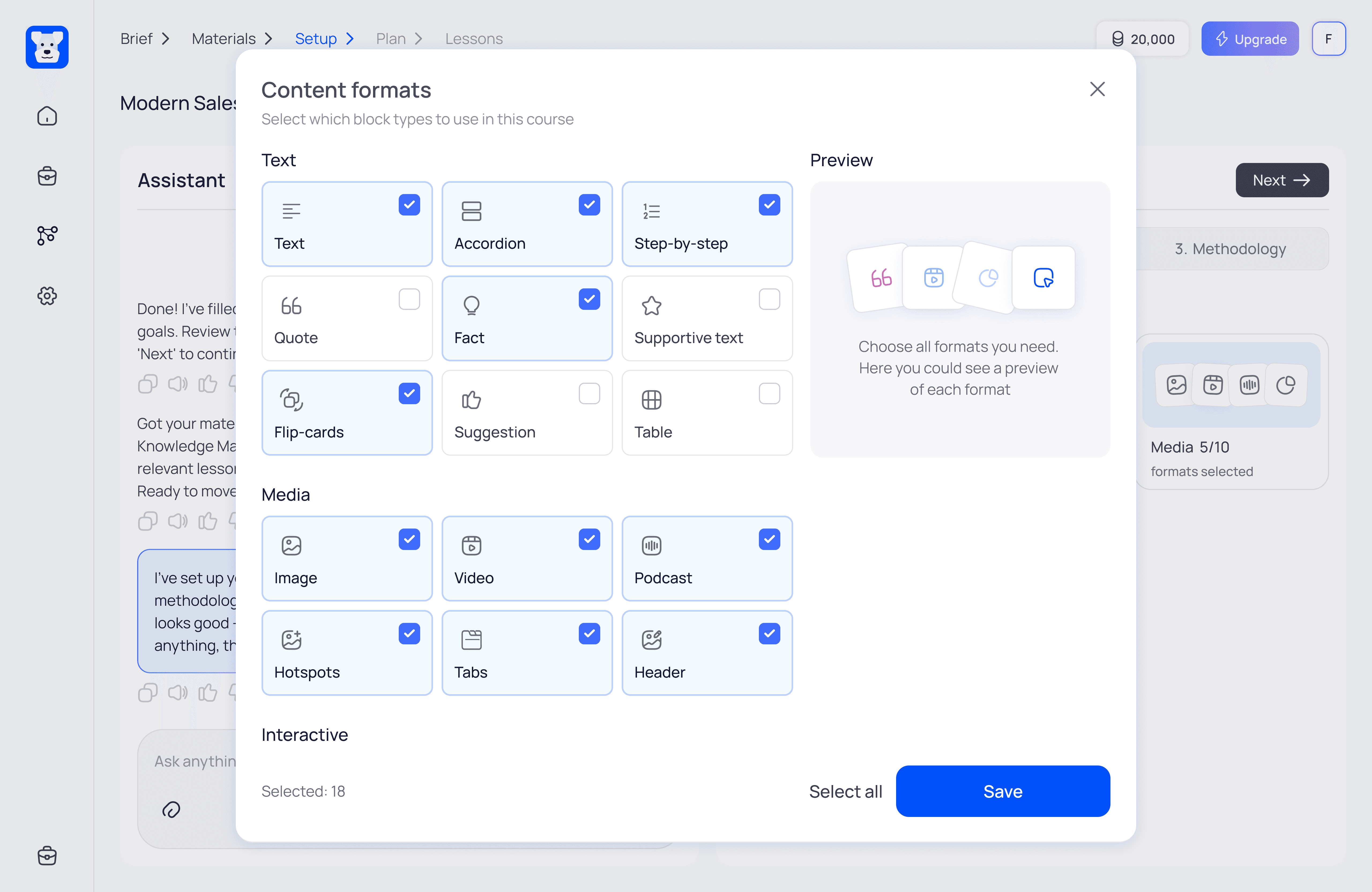
All of these 5 multimodal strategies you can easily build with the help of Foxtery. Foxtery has 40+ interactive formats that allow your employees learn faster and save 40-60% of time compared to traditional methods.
Why gamification increases motivation by 83%
Gamified training increases employee motivation 83% when learning includes game-like elements. This effect stems from engaging multiple modalities simultaneously:
visual feedback through progress bars and badges,
kinesthetic interaction through clicking and decision-making,
emotional engagement through competition and achievement.
Gamification works because it transforms passive content consumption into active participation. Leaderboards create social pressure. Points systems provide immediate feedback. Scenario-based challenges require application.
The connection to retention is direct: active engagement improves recall 50% versus passive learning. Gamification is simply structured active engagement.
Implementation doesn't require custom platforms. Start with quiz competitions where teams race to complete knowledge checks. Add progress tracking that visualizes completion percentages. Introduce scenario challenges where employees earn points for optimal decisions.
How to build your first multimodal training module in 30 minutes
Step 1 (5 minutes): Identify the learning objective and upload your materials.
For a product feature launch, choose video demo (visual + auditory), interactive quiz (kinesthetic), and PDF reference guide (read/write).
Step 2 (10 minutes): Record a 3-5 minute explainer video.
Use screen recording software to demonstrate the feature while narrating key points. No editing required (authenticity matters).
Step 3 (10 minutes): Build a 5-question interactive quiz.
Create scenarios where learners apply the feature to customer problems. Provide immediate feedback explaining why answers are correct or incorrect. This transforms assessment into a learning modality.
Step 4 (5 minutes): Create a one-page downloadable checklist.
List the steps demonstrated in the video as a quick-reference job aid. This read/write modality serves as performance support during real customer interactions.
Step 5: Deploy and measure completion plus quiz scores.
Track which employees complete the module and how they perform on scenario questions. Low quiz scores indicate knowledge gaps requiring follow-up.
This 30-minute investment creates a multimodal learning experience engaging visual, auditory, kinesthetic, and read/write modalities—proven to increase retention up to 80% compared to text-only training. Platforms like Foxtery are designed specifically for this workflow, enabling L&D teams to combine video, interactive assessments, and downloadable resources into a single course in 30 minutes rather than 30 days.
How to justify multimodal training investments to your CFO
Companies that implement eLearning save 40-60% in training time compared to traditional classroom delivery. For an organization training 500 employees annually, that's 200-300 hours of productivity returned to revenue-generating work.
42% percent of companies report increased revenue from eLearning implementation, attributed to higher productivity and faster skill application. The connection is direct: better retention means employees apply skills correctly sooner, reducing errors and rework.
Retention ROI compounds over time. Higher knowledge retention eliminates repeat trainings for the same content. Fewer errors reduce quality costs and customer complaints. Faster ramp time for new hires shortens the period before they contribute revenue.
Scalability creates the strongest financial argument. Digital multimodal content reaches 10 or 10,000 employees without linear cost increases. A single well-designed module serves the entire organization, while classroom training requires repeated instructor time and facility costs.
With 98% of corporations using online learning, not investing in multimodal approaches means falling behind competitors who are already delivering faster, more effective training to their teams.
Conclusion
Multimodal learning exposes a gap most L&D teams don't want to acknowledge: training programs optimized for content delivery rarely optimize for human memory formation.
Enterprise software is moving multimodal whether L&D departments participate or not. Platforms like Foxtery enable rapid development that matches business speed - product launches, compliance updates, and new hire onboarding can't wait 6 weeks for training creation.
Frequently Asked Questions
What is the difference between multimodal learning and learning styles?
Multimodal learning provides varied content formats (visual, auditory, kinesthetic, textual) to all learners simultaneously, while the learning styles theory incorrectly suggested matching one preferred mode per person.
How much does it cost to implement VR training for a company?
VR training becomes cost-effective at scale. PwC's research found that at 3,000 learners, VR training costs 52% less than classroom delivery. Initial investments include headsets ($300-$1,000 per unit for business-grade devices) and content development ($10,000-$100,000 depending on complexity).
Can multimodal learning work for remote employees?
Multimodal learning works exceptionally well for remote employees because digital delivery naturally supports multiple formats. Video combines visual and auditory modalities. Interactive quizzes provide kinesthetic engagement. Downloadable job aids serve the read/write modality. Mobile accessibility allows learning during commutes or flexible schedules.
What is the minimum number of modalities needed for effective multimodal training?
Effective multimodal training requires at least 2 modalities per learning objective. The most practical combination pairs video (visual + auditory) with an interactive element (kinesthetic) such as a quiz or scenario. Adding a third modality like a downloadable reference guide (read/write) strengthens retention further.
How do you measure whether multimodal training is actually working?
Measure multimodal training through completion rates, knowledge retention tests at 24 hours and one week post-training, time-to-competency metrics, and business outcomes like error reduction or sales performance. Compare these metrics against previous single-format training baselines. Track engagement indicators like video watch time, quiz scores, and simulation attempts. Survey learners on format preferences and perceived effectiveness - VR training shows 95% satisfaction in preparing for real situations.
Is multimodal learning only effective for certain types of training content?
Multimodal learning improves outcomes across all content types, though format selection varies by objective. Technical procedures benefit from video demonstrations plus hands-on simulations. Soft skills like leadership require role-play scenarios and discussion. Compliance training uses video plus interactive quizzes to maintain engagement. Product knowledge combines visual demos with downloadable reference materials.

